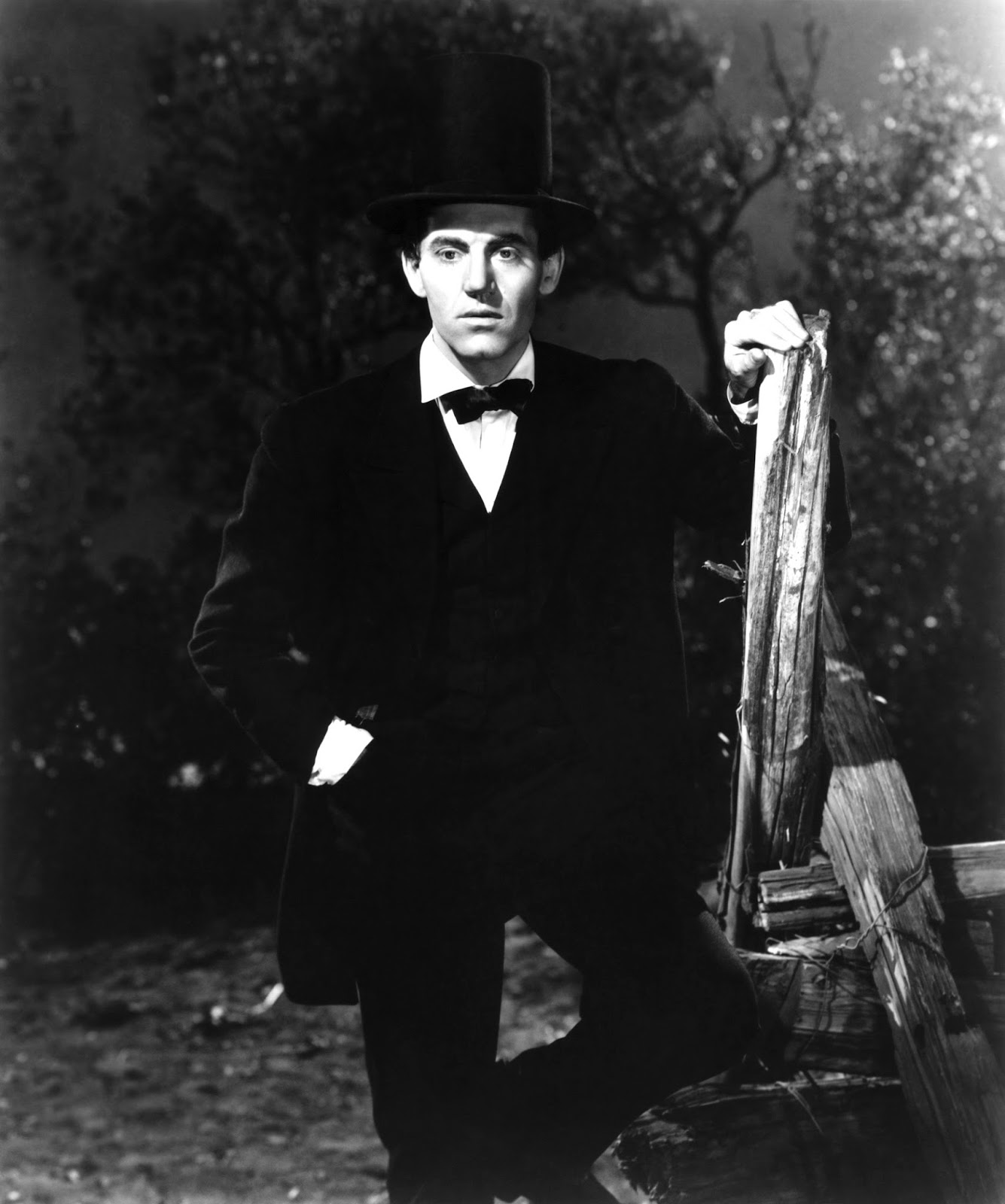
directed by John Ford, starring Henry Fonda, Alice Brady
(Note: This is my entry in the John Ford Blogathon, hosted by Krell Laboratories.)
Young Mr. Abraham Lincoln (Henry Fonda) is a man of weighty thoughts but light experience, at least when it comes to the rule of law. All he really knows, he's only learned from books. But after he loses his first love Ann Rutledge (Pauline Moore), Lincoln makes up his mind to study the law in earnest. However, his first case will prove to be as great a challenge as he could ever have imagined.
The Clay family have come to town for a Fourth of July celebration. At the fair, the two brothers (Richard Cromwell and Eddie Quillan) get into a fight and a man ends up dead with a knife in him. Both Clays are accused of murder. Both are determined to take the blame, trying to spare their brother from a hanging. Their mother (Alice Brady) is a witness to the crime but absolutely refuses to say a word; she'll never sacrifice one to save the other. The other key witness to the crime is J. Palmer Cass (Ward Bond), a friend of the victim; he insists that he saw the stabbing by the light of the moon and refuses to budge on that point.
Lincoln agrees to take on the case, but all the fates seem against him. He's got a town braying for the blood of the two Clay boys, a town that's ready to lynch them at any second. He's got a jury that's already biased against the case. He's got no testimony to counter the accusations. His defendants won't tell the truth of what happened. And he himself is as green a lawyer as ever walked into a courtroom. But that won't stop him from putting up one hell of a fight. Little does he know that it's only the beginning for him.

Of all our presidents, Abraham Lincoln is arguably the most cinematic. Theodore Roosevelt and Andrew Jackson had more bombastic personalities and George Washington was the more standardized hero, but Lincoln stands out as uniquely well suited to the big screen. He's both the approachable, folksy "rail-splitter," the common man striving to better himself, and the mythical, untouchable paladin for human rights. He's a figure we can look up to in awe, but, to snag an old election phrase, someone we could also imagine wanting to share a drink with. Consider that in the very same year, we got both a big-budget, prestigious, Oscar-nominated film inspired by Lincoln's efforts to pass the Thirteenth Amendment and a splashy fantasy action flick about Abraham Lincoln, the vampire slayer. Lincoln presents, in many ways, the archetypal image of what Americans want to think about themselves. Sharp and tricksy but also reasoned and wise. Compassionate yet stern as steel. A humble background but the will for power.

John Ford's 1939 biographic film, Young Mr. Lincoln, is a testament to those ideas of Abraham Lincoln and in that regard, it's a beautiful, modest, rather slippery piece of work. "Biographic" is a term I use very loosely here, because the movie has little interest in retelling the facts of Lincoln's life. It marks off a lot of the famous little anecdotes about his early career, like the time when he told the story of the dog and the pitchfork in court or the time he asked Mary Todd to dance ("I want to dance with you in the worst way"). But it carries precious little in the way of facts. The movie invents wholesale a story about him defending a pair of accused murderers and devotes most of the runtime to that. With the overwhelming abundance of storytelling material in Lincoln's actual life, the choice to depict him as a crusading Atticus Finch seems oddly limiting at first glance.
However, once you get past that mental hurdle, Young Mr. Lincoln offers a portrait of Lincoln that is deeply affecting and more complicated than you might expect from the synopsis. In fact, the Lincoln here has a lot in common with the 2012 Spielberg version of Lincoln. They're both presented as canny, thoughtful men, not above using a little trickery or insults to get their way. The Lincoln in this film cracks lowbrow jokes, hems and haws over his true intention and calmly manipulates people. He even cheats to win a game of tug-of-war at one point and John Ford cuts away without tipping his hand as to whether we're supposed to applaud his smarts or be disconcerted by his casual disregard for rules. Without showing Lincoln's political career, the 1939 film manages to throw in a great many hints about his political aptitude. This film also highlights Lincoln's essential isolation from other people, ending in a famous scene of him walking alone up a hill that surely must have been in Spielberg's mind when he filmed the final scene for his version. The key difference between the 1939 and 2012 biopics is that the Spielberg story is about the collaboration and compromises Lincoln and other people must make to form that more perfect Union. Ford's film, by contrast, presents Lincoln as a singular figure, one whose struggles are not truly shared or understood by anyone else.

Sometimes, an actor's star persona is virtually indistinguishable from his offscreen one, as in the case of Clifton Webb. Other times, it's almost a night and day contrast; the down-to-earth homemaker turns into a sultry temptress on silver nitrate or vice versa. Personally, I hold to the theory that you can usually unearth bits and flashes of the actor's true self underneath the performance, no matter how wide the gulf seems at first. Vincent Price's joy in living, Joan Crawford's drive for self-improvement, Rita Hayworth's need to please. It's there if you know where to look for it. But Henry Fonda is one actor that strains that theory of mine to the breaking point.
On film, Henry Fonda is the purest personification of honesty. He isn't just a good guy. He's the hero struggling in the dark, his eyes fixed on some distant mountain peak of perfection that the rest of us can only imagine. He could take characters as decent and honorable as Tom Joad, Juror No. 8, Wyatt Earp, and Abraham Lincoln and convince you that they were possible. And yet in real life, Henry Fonda was a cold, unreachable man who alienated his loved ones and quite frankly, acted like a shit to them much of the time. After you've read a few of the Fonda family bios, it seems frankly unbelievable that this man could dig deep enough to find the fathomless generosity and compassion of his most famous roles.

However, when you look at Henry Fonda and compare him to the other famous "good guy" actor, James Stewart, the connection snaps into place. The hallmark of a Fonda hero, as opposed to a Stewart hero, isn't heartfelt emotion, it's thought. Fonda heroes are always staring off somewhere into the middle distance, thinking their way towards a solution. Unlike Stewart, who so often ends up loving too well and not too wisely, Fonda is more isolated, more cerebral and less open. In Mr. Smith Goes to Washington, Stewart's climactic speech has him distraught and anguished, voice cracking, fiery and exhausted. In Grapes of Wrath, Fonda's famous speech has him looking offscreen, patient and undaunted, slowly struggling his way towards the understanding that he himself belongs to a larger whole. And there is a certain coldness to that kind of hero. He can't belong to us in the way Stewart can.
All this is leading up to a notion of mine that when Henry Fonda plays the John Ford hero, it results in films that tend to be quieter and less easy to pin down than Ford's films with John Wayne. My Darling Clementine, The Grapes of Wrath, and Young Mr. Lincoln all have their fair share of Fordian humor and American nostalgia, but they keep us at more of a distance (I have a feeling that Mr. Roberts might be the exception that proves the rule but don't tell me, I still haven't seen it).

I realize that I have spent almost this entire review talking about Henry Fonda and not the supporting cast, which includes some famous names, including Ward Bond, Donald Meek, Alice Brady, and Richard Cromwell. And that's for the very good reason that this film is really Fonda's showcase the whole way through. When he's not onscreen, you're waiting for him to come back. The other characters don't really register, although I appreciate the sly touch of having the aptly-named Donald Meek play Lincoln's slick, confident opponent. Alice Brady's performance as the anguished mother of the defendants is also good, but the script rarely gives her more than one note to play. Truthfully, Young Mr. Lincoln, while a great character study for its protagonist, does suffer a little by making the supporting characters so simple. John Ford films in general rely heavily on archetypal characters, but I can't help feeling that they came across as richer and deeper in movies like How Green Was My Valley or Stagecoach than they do here.
The greatest joy this film has to offer for John Ford fans, aside from Fonda, is the aching beauty of its camerawork. His shots of Lincoln rambling through the woods look like something you want to hang in a gallery, they're so well framed. Ford's ability to find both emotion and mythic resonance in his stories is also just as evident here as it is in his more famous films. There's an early scene with Lincoln talking to his first love Ann Rutledge out near the river. She encourages his dreams, he compliments her hair. The sun is shining. The mood is tentative and hopeful; their romance is just barely beginning. When she walks away, Lincoln tosses a stone in the river. The ripples slowly transition to shifting blocks of ice in the dead of winter. The camera finds Lincoln making a slow, deliberate walk to Ann's grave to replace the flowers there. The cruel, lovely simplicity of the image cuts straight to the bone.
For me, the best John Ford films are built on moments like that. Moments that make us feel like we're seeing an elemental truth of human experience. While I wouldn't rank Young Mr. Lincoln as one of his greatest films, if only because his best is so very great, it carries enough of those moments to make me very glad that John Ford and Henry Fonda chose to make their idea of Abraham Lincoln. In 1939, they were without a doubt the best men for the job.

Favorite Quote:
"What I'm afraid of is that some of the jurors might not know you...and that'd put me at a great disadvantage."
Favorite Scene:
The scene in which Lincoln takes on an angry lynch mob. It's a simple scene on the surface, but it's so elegantly constructed that if I taught film classes, I'd make it required viewing for all my students. Abraham Lincoln has just taken on the case of the two Clay brothers and a raging mob descends on the cell, ready to storm it and kill the boys then and there. Lincoln appears just in time and throws himself between the crowd and the door, armed with nothing but his lanky body and the sound of his voice. Rather than just appealing to their better natures or diffusing the situation with humor or angrily calling them out, Lincoln applies all these strategies in one speech, revealing his incredible political aptitude for the first time.
I love the way that Ford matches the shifting camera angles to Lincoln's shifting tactics. In the first part of the scene, when Lincoln appears in front of the door, Ford's camera goes for a jarring, extreme close-up of his back turning around. When he turns, the camera has traveled sharply away from him and he's a distant, almost frightening figure in black, loudly proclaiming that he'll beat up anyone who tries to pass him. As the crowd argue with him, Lincoln gradually turns the conversation into subtle mockery, poking fun at himself in order to draw a laugh from them ("I'm just a fresh lawyer trying to get ahead...and you boys act like you want to do me out of my first clients"). Ford brings the camera closer and now Lincoln is in the middle of the frame. He's more approachable now, but rather cool and dispassionate. The crowds starts to calm. Ford cuts to a beautiful closeup of Lincoln, now leaning against the doorframe, his head bowed. He begins speaking regretfully of the nature of lynch mobs, subtly drawing the conversation away from the comical waste of money to the real moral cost. The humor's gone. Then he actually calls out one of the mob by name, reminding him of his honorable name and piety. He paints a picture for the crowd of this same man going home to read his bible and turning to the passage, "Blessed are the merciful for they shall obtain mercy." By now, the crowd has been thoroughly subdued. Their battering ram is almost slipping from their hands. Lincoln looks up and says softly, "Why don't you put it down for a spell, boys, ain't it getting heavy." He has won a total victory. Moreover, Ford's camerawork matches Fonda's performance so perfectly in this scene, Lincoln can't help but win over the movie audience as well.
Final Six Words:
Wise, wistful portrait of elusive legend


_02.jpg)


