Saturday, September 24, 2011

Fashion in Film Blogathon: A Letter to Three Wives


Fashion Spotlight on A Letter to Three Wives

Have I lured you all in with that gorgeous Jeanne Crain photo? Well, the Fashion in Film Blogathon has arrived, courtesy of the lovely and stylish Angela over at The Hollywood Revue. In honor of the day, I'm going to try something a little different from my usual list-making and movie-reviewing habits. I'm going to do a scene-by-scene fashion analysis of one of my favorite movies, Joseph L. Mankiewicz's A Letter to Three Wives.

I love this movie for many reasons. Its witty script, the talented cast, the biting social commentary, I could go on. But I also love the way it uses costume. Even though the film is about three beautiful, upper-class women, the costuming isn't used just as a glamor assault (although that would be fun), but as a way to subtly comment on class and character differences. Each of our three main protagonists has her own look and her own place on the social ladder.

For those who are unfamiliar with the plot of A Letter to Three Wives, I'll do my best to give the context for each scene. While I normally avoid recapping films, I think in this case, a little plot summary is required. Now, on to your irregularly scheduled fashion spotlight.


Let's start with two of our protagonists: Rita Phipps (Ann Sothern) and Deborah Bishop (Jeanne Crain). Rita, on the left, is married to a schoolteacher and brings in some much-needed money for the family with her radio writing. She is the mother of twins. Deborah, on the right, is a farmer's daughter who met her wealthy husband while they were both in the Navy during World War II. They're on their way to a charity event (taking underprivileged children on a riverboat ride and picnic). Rita and Deborah both belong to the country club set and their clothes reflect that. They're not overdressed but they still care enough to wear jewelry and white gloves, along with their sharply tailored jackets. Could you guess that these two were on their way to a picnic?


Enter our third wife, Lora Mae Hollingway (Linda Darnell). She's the young wife of wealthy businessman Porter Hollingsway, the richest man in town. Lora Mae is even more dramatically dressed than her friends, befitting her status. That jacket is more blindingly white than sunshine glinting off the polar ice caps. Personally, I would worry about some kid putting their sticky hands all over it, but I'm not the wealthiest woman in town.


The plot thickens. Their absent fourth friend Addie Ross has left them a note, telling them she's run off with one of their husbands. But she doesn't tell them which husband. This shot has nothing to do with costume but I have to say, I love Addie's handwriting.


This is a superb example of what I'd call "costume choreography." When the wives huddle together, we suddenly see how perfectly their outfits complement each other. Notice how Ann Sothern, with her dark jacket, white blouse, and blond hair is an almost perfect photo-negative of Linda Darnell's white jacket, dark scarf, and brunette hair. Jeanne Crain would be odd woman out, except that her polka-dotted scarf ties her visually to the other two, as well as contrasting with Sothern's striped collar. It makes complete sense for the wives to be visually linked because at this moment, they're all thinking the same thing. "Is it my husband?"


We flashback to Deborah as a new bride, on the night of her first country club dance. Deborah is practically tearing her hair out with anxiety because she has no experience with this kind of crowd. Her husband Brad tries in vain to console her. Here she is in her robe. Note the floral pattern and girlish ruffle. This robe probably comes from back home on the farm; she hasn't had time to get any new things.


After knocking back way too many martinis, Deborah comes downstairs in the only party dress she owns. And I have to say, this is the dress that made me pick A Letter to Three Wives for my blogathon entry. This thing is a genuine miracle of costuming, a valentine to bad taste. The bunchy sleeves, the big flounce at the bottom, those giant fake flowers that look like a space alien attack...it's so great. As much fun as it is to see Hollywood designers dress a woman beautifully, it can be equally fun to see them dress her horribly. This dress is a smacking visual reminder of the huge gaping difference between Deborah's simple farming background and the glittering social set she's married into.


The first meeting of Deborah and Rita. While Deborah collapses in despair, let's take a look at Rita. I'm not wild about this dress: it's sort of giving me a "Little-Miss-Muffet-Sat-On-Her-Tuffet" vibe. But it does provide a strong contrast to Deborah's floral disaster; unlike Deborah, Rita is an experienced wife and mother. Her dress is black, in a sober, conservative style that the country club set would find age-appropriate. By 1940s standards, Rita is moving into the "matronly" category.


Rita and Deborah bond as they attempt to improve Deborah's dress. Incidentally, the husbands are waiting outside, completely oblivious to the costuming turmoil.


 We arrive at the country club dance to meet Lora Mae and her husband Porter (Paul Douglas). The gruff and tough Porter looks on as his wife dances with another man. "If she was dancing with a tramp, she'd look like a tramp, got no class of her own. I like class." This is our first hint that Lora Mae and her husband aren't exactly the silver spoon type. We get another, much subtler, hint with Lora Mae's dress. Unlike Rita, Lora Mae has gone for a much more striking and sexy look, with bared shoulders and glittering collar and cuffs. While it keeps well within the bounds of taste, there's something about all the sparkle and skin. Rita seems to be hiding. Lora Mae is displaying herself.


Brad (Jeffrey Lynn) drags his wife Deborah onto the dance floor, failing to realize that she's completely drunk. As she tries to plead with him, Brad goes for a spin, only to rip the remaining flower off Deborah's dress. The flower lands on someone's plate, there's a hole in the dress, and Brad can't understand what just happened.

As Deborah's flashback ends, she reflects on how the mysterious Addie Ross would never have blundered in such a way. Unlike Deborah, Addie comes from Brad's social class.


We leave Deborah and enter Rita's backstory. Rita is planning a big dinner party to impress her employer, the formidable Mrs. Manleigh. Unlike the other two couples, Rita and her husband George (Kirk Douglas) belong to the upper class only by birth, not by money. They have to scrimp and save to support a family on his teaching income and her radio writing money. But Rita is ambitious and eager to succeed in her career. Here she is getting ready with her maid Sadie (Thelma Ritter). Got to love that Lucy Ricardo-esque hairdo that Ann Sothern's sporting.


When we get to the party, Rita's pretensions become painfully obvious. In her desire to impress the Manleighs, she appears in this glittering white dress, trying to act as if this is normal dinner wear for her. It's beautiful and flattering, but there's something a little off about it too. Rita's the mother of twins, she's a career woman, she's smart and sophisticated and yet this dress is so demure, so innocent. It's a fake.


Get a load of Sadie's formal outfit here. Rita is trying so hard to act as if her income was three times what it is.


A brief shot of Mrs. Manleigh (Florence Bates). Not much to point out here as Mrs. Manleigh is dressed respectably for a middle-aged woman, but you can see at a glance that she probably didn't take much time at all to get dressed for this party. It's a huge deal for Rita but it means very little to her. In the next scene, Mrs. Manleigh will end up breaking George's classical record, a birthday gift from Addie Ross.


And we can see that Lora Mae is just amused by the goings-on. This shot doesn't give the full effect of Lora Mae's dress which is simple enough except for the floor-length overskirt that ties in the middle. It's an unusual enough style that I tried to find out if Lora Mae is showing off some 1940s trend, but my research yielded nothing. Still, look how she's comfortably sprawled, while Rita, in her dainty white dress, has to sit with perfect china-doll posture.

Rita's party ends in disaster when George, fed up with Mrs. Manleigh's constant rudeness the whole night long, tells her exactly what he thinks about schlocky radio writing. George and Rita have a fight. As George storms off, Rita thinks bitterly about Addie Ross. Addie who remembered George's birthday when Rita didn't. Addie wouldn't have been caught in this mess.


Rita's flashback ends and we're back in the present. Rita confronts Lora Mae about their problem, but Lora Mae insists that it doesn't matter whether or not her husband ran off with Addie Ross. She's got Porter's money and that's all that matters. Apparently Lora Mae is the only woman who thought to bring along pants and boots to this picnic. Oddly appropriate for a scene in which she's talking about how she doesn't need a man.
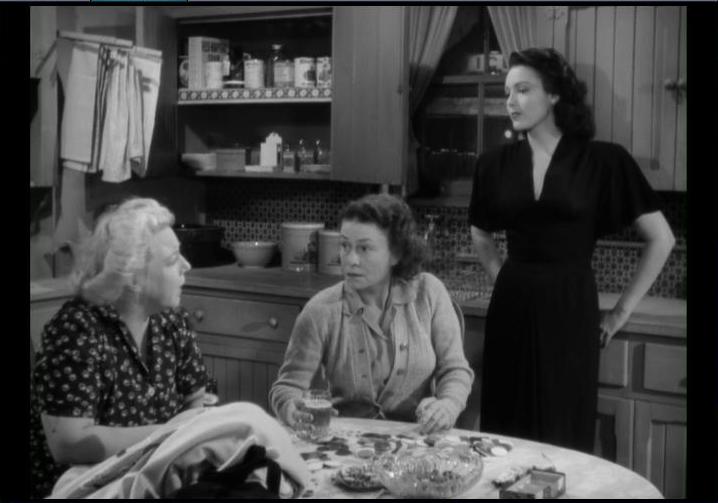
Sadie: "If I was you, I'd show more o' what I got. Maybe wear somethin' with beads."
Lora Mae: "What I got don't need beads." 

Now, we come to the third segment of our program: Lora Mae and her gold digging past. She didn't just come from the wrong side of the tracks, she came from a house right next to the tracks (in a running gag, the house shakes like mad with every passing train).  Poor but gorgeous Lora Mae has snagged a date with her boss, the wealthy Porter Hollingsway. While her family frets over the indecency of it, in strolls Lora Mae, cool as a cucumber, in this elegant little black dress. The neckline's low without showing a hint of inappropriate cleavage and it hugs her figure without clinging. Unlike the stereotypical gold digger, Lora Mae subverts expectations by showing us (and Porter) that she's got "class."


Lora Mae has grabbed Porter's attention, but she's angling for more than that. After finding a portrait of Addie Ross adorning Porter's piano, she tells him what she wants. "I want to be in a silver frame on a piano. My own piano in my own home." Note Lora Mae's look here, just a simple blouse and a skirt. Again, she's not going for anything flashy, but she's doing her best to look attractive and respectable. It's all to show Porter that she's no cheap girl on the side.


Having made her point, Lora Mae puts on a plain coat and striped scarf that undermine the sophisticated, "woman-of-the-world" attitude she was going for earlier. It's a quick reminder that Lora Mae, for all her attempts to dress well, is still poor. She's probably had that scarf since high school.


Porter is infatuated with Lora Mae but refuses to marry her. We cut to New Years at Lora Mae's house. Her sister, Babe (Barbara Lawrence), is borrowing Lora Mae's best dress for a date. And here, the costumers made a grave error. No way was that fussy little dress, with those puffed sleeves and cheap, crinkly material, Lora Mae's best dress. When she was fourteen, maybe.


Lora Mae has stayed home to mope. And she's put on her moping clothes, a big-buttoned cardigan, a white blouse, and a scarf to tie back her hair. I love this costuming detail, really I do. Classic movies often chose to ignore the fact that beautiful women didn't always lounge at home in perfectly pressed skirts and pearl necklaces. So it's jarring and rather wonderful to see Linda Darnell appear in something so ordinary. Stripped of her armor, so to speak. So of course, this is the moment when Porter barges in to tell Lora Mae that he can't bear to let her go. "Okay you win, I'll marry you."


Our flashback ends and we cut back to the present. The wives have all gone home, frantic to see if they've lost their husbands. Rita rushes home and finds her husband waiting.  Turns out he's been helping his students rehearse for the school play. Thrilled, Rita calls up Mrs. Manleigh to tell her that while she likes her work, she's not going to be bossed around anymore. No costume changes although Rita's jacket and George's robe match up well together. They're now in sync.


Deborah comes home and discovers that Brad has stayed away overnight. She is now convinced that her husband has run off with Addie. Note that the color of Deborah's jacket almost exactly matches the wall. She's disappearing into her big, expensive, and empty house.


Lora Mae, trying to act unconcerned, comes home and tells her mother that Porter probably won't come back, only to have her grumpy husband stroll through the door. The two snipe at each other. 

Lora Mae has switched her outfit and now appears in a dramatic two-tone dress, with a sash at the waist and those Mildred Pierce shoulder pads. I could make an elaborate metaphor here about the contrasting colors and how it represents Lora Mae's divided nature, but you know, I just think the 40s really liked two-tone dresses.


It's the night of the country club dance. Rita and George go to Deborah's house where the icily controlled Deborah informs them that Brad isn't coming. And just look at Deborah! She's gone from looking like a hayride hallucination to an elegant society woman in this black evening gown. The glittering metallic detail adds to the frosty impression that Deborah is giving off. She's also trailing what looks like a very expensive fur. In a way, this costume is a moment of triumph for Deborah, proving that she can play the society game. But there's a sting in it. As we found out in an earlier scene, Brad picked this dress for her...because it was one that Addie wore once.

Rita on the other hand, has gone in an opposite direction. She looks almost too casual in a white buttoned-up blouse and long skirt. However, while it makes me a little sad that Ann Sothern won't be glammed up for the finale, it does make sense for the character. Now that Rita has given up the fawning, socially pretentious attitude she put on for Mrs. Manleigh, she's not going to pretend to be any wealthier than she is.


We get to the dance and meet Porter and Lora Mae. Porter looks over at his wife dancing with another man and grumbles. Deborah tells him off. "Have you any idea how much Lora Mae's in love with you? So much, she's afraid to tell you. Afraid you'd laugh at her." Tired of pretending everything's alright, Deborah stands up and tells them all, in a perfectly calm voice, that her husband has just ran off with Addie Ross.

As Lora Mae and Porter look on in disbelief, let's look at Lora Mae's dress. It's very similar to her earlier party dress except that she's gone for a statelier look with a rolled collar and cuffs, looser sleeves, and no metallic detail on the dress. Her one extravagance is that long, dangling necklace. Fittingly, it stops right at her heart. Porter is convinced that Lora Mae is in love with his money. Does her heart belong to the jewelry or to him?


Porter reveals the truth. Brad didn't run away with Addie Ross. Porter did...until he changed his mind. He turns to his wife. "They all heard me say I ran away with another woman. You've got everything you need, you can take me for everything you'll ever want."

But Lora Mae won't have it. "If you said anything, I just didn't hear it." Porter looks over at her, realizing for the first time how they really feel about each other. Lora Mae's bare shoulders, instead of playing up her sexuality, now seem to make her more vulnerable to Porter's searching gaze.


Our comedy ends. Deborah goes home to wait for Brad and our other two couples begin to dance. Addie Ross is gone and suddenly the future seems a whole lot brighter.

The prolific Charles Le Maire was the wardrobe director for A Letter to Three Wives, while the underrated Kay Nelson (Oscar-nominated for Mother is a Freshman) designed the costumes. While her designs here aren't the kind of bravura work that wins awards, they are an excellent example of classic Hollywood costuming that works at every level to enhance the story. Each of our three protagonists has her own style, her own concerns, and her own budget to work with. And by the end of the film, Rita, Deborah, and Lora Mae have all gone through a journey that is perfectly visible through their costume changes. A great bit of costuming from a great and fun film.

Have a happy Fashion in Film Blogathon, everybody! 

The lovely Jeanne Crain image is credited to a link from Dr. Macro.

Monday, September 19, 2011

Dior J'adore: Reliving Hollywood Glamor


So, I've watched the new Dior ad about five times now and I'm still not sure what to think about it. For those who haven't seen it, Dior's ad for J'adore perfume features not only the actress Charlize Theron, stalking proudly through the Hall of Mirrors at Versailles, but the images of Grace Kelly, Marlene Dietrich, and Marilyn Monroe, brought to life through CGI. The living actress kisses Kelly on the cheek, glances over at the tuxedo-ed Dietrich, and, in the ad's most surreal moment, hands Monroe a bottle of perfume, as Marilyn whispers in a breathlessly worshipful tone, "Dior...J'adore." The ad ends on an image of Theron strutting down the catwalk, her sparkling gold figure turning into the Dior bottle.

My first reaction was a full-body shudder of, "Oh God, they're using dead women to hawk their perfume." Somehow, the thought of CGi-ed, reanimated actresses giving their seal of approval to a current product is frightening. The ad even seems to acknowledge this by hitting a "scare chord" at the moment when Grace Kelly first turns around. But I have to admit, there was an element of pleasure to the ad as well, in seeing these iconic legends again. When I showed the ad to my mom, she had fun picking out the actresses and told me afterward, "It's much more respectful than I thought it would be."


And she has a point. Except for the deeply jarring moment when Marilyn speaks (and wasn't she a Chanel woman anyway?), the ad can be taken as a simple homage to old-style Hollywood glamor. Which is a pretty clever choice for an ad campaign and a perfect association for a perfume. Scent evokes memory, after all. A great perfume can do more than attract a mate or match an outfit, it can trigger something deeply personal in our minds. Because of the way the ad is staged, the sense I got from it was not so much "Wear our perfume and be like Marilyn," but "The glamor of the past gives way to the glamor of the future."


 Of course, just because the ad has a good thesis doesn't mean it's a successful one. Charlize Theron is a stunning woman who, on the basis of her looks alone, could go toe to toe with any of these actresses. But in terms of iconic glamor and star power? They leave her completely in the dust. This isn't Theron's fault. I think it would be the same problem whether the ad featured Anne Hathaway, Halle Berry, or Mary-Kate Olsen. The star system is gone and with it, the idea that actresses could be goddesses. This ad doesn't just remind us of classic Hollywood glamor, it reminds us of how completely it's gone extinct.

The ad raises interesting questions for me. How far is it acceptable to go in using these iconic images? Can loving nostalgia co-exist with such an eerie use of our current technology? And why, in an ode to the past, did they choose a song with the lyrics, "If it's already been done, undo it?"

Monday, September 12, 2011

Miscastings in Classic Film


It's time for a list. And today, my chosen topic is:

If I could go back in time and change just one casting choice from one classic movie.

Now I must preface this list by saying that I'm mainly criticizing the casting, not the actors themselves. With perhaps one exception, my feelings for the actors listed below range from indifference to heartfelt love. I just don't believe they were suited for these particular roles. And I chose to go after films I consider true classics. There's little point in going after, say, Victor Mature in Samson and Delilah. And, even though I couldn't resist using the photo of John Wayne as Genghis Khan, I'm not going to go after Hollywood's long history of racial miscastings in this post. Mickey Rooney's portrayal of Mr. Yunioshi in Breakfast at Tiffany's may be an epically horrible stain on an enjoyable film, but the character would have been a racist caricature no matter who was playing him. For this list I want to talk about good characters, good movies, good actors and bad casting. So let's begin.

1. Valerie Hobson in Great Expectations


I have to confess a bias here: Estella is one of my favorite Dickens characters. She's that rarity: a Dickens heroine who isn't innocent and wholesome. Instead, Estella is an icy, damaged character, the Catwoman amongst the pigeons. She has humor and honesty and she feels something for Pip, but because of her upbringing, she can't be normal. Maybe she never will be. Because I love Estella, I had high hopes for Valerie Hobson's portrayal. Alas. Hobson is pretty enough but she's so prim and proper. She tries to sound like a heartless femme fatale and ends up sounding pert. Hobson would have made a fine Gwendolyn Fairfax, but as Estella? No. It's a pity because Jean Simmons as the younger Estella is so perfect. If only she could have played both parts.

2. Humphrey Bogart in Sabrina


Bogart's casting, as the harried workaholic Linus Larrabee, isn't so much a disaster as it is a collection of small annoyances. There's his age for one thing, a common problem with Hepburn's costars. There's the fact that he's playing a privileged businessman. Bogart always seemed more comfortable sneering at the upper crust than in playing their games. But the biggest problem, for me, is that he never strikes sparks against Hepburn. Bogart's best leading ladies were as flinty and fearful of surrender as he was, from the high-toned, scheming Mary Astor to the romantically tormented Ingrid Bergman. Hepburn is too elfin, too warm, to play ball with him. For her part, Audrey Hepburn needed leading men who were willing to be charmed, even if it meant letting her steal the light. Bogart was not that man. You can feel his discomfort. This is the itchy wool sweater of romantic comedy performances.

3. Cecil Kellaway in The Postman Always Rings Twice


Cecil Kellaway as the gruff, Greek husband of Lana Turner--I've already ranted about this one at some length. It still makes no sense to me.

4. Nora Gregor in La Règle du jeu


Jean Renoir's masterpiece about the boredoms and manipulations of France's upper class needed a strong leading lady to stand at the center, someone who could be both shallow and seductive. This character, Christine de la Chesnaye, is an aristocrat's wife, mired in the romantic gamesmanship of her class and too weak to break free from it. She is the object of many men's obsessions, but she can't hold on to her husband. She has the chance for escape but it eludes her. There's silliness to her, but tragedy too. For that kind of role, you need a talented and charismatic actress (I'm thinking of Arletty in Les Enfants du Paradis). Instead, we have Nora Gregor, who is just inadequate. She flutters, she pouts, she trembles. She has the mannerisms of a custard pudding. Gregor's Austrian background does allow Renoir to make a clever reference to Marie Antoinette and she gets more tolerable as the movie goes on. But the emotional weight of her character is left up to Renoir. Gregor doesn't spoil the movie but still, I ache for what Danielle Darrieux could have done with this role.

5. James Stewart in Rope


If you put me in front of the firing squad and told me to name my favorite actor, Jimmy Stewart would be it. I very rarely have a problem with Stewart's casting in anything. And Stewart and Hitchcock brought out the best in each other. So it's odd that his portrayal of the sharp-tongued, suspicious, possibly-gay Rupert Cadell in Rope does so little for me. On the surface, it seems like a fine choice. Stewart could spout witticisms about murder without losing audience sympathy and he didn't shy away from darker characters. But Stewart never seems comfortable in the role of this erudite shithead and quickly escapes into playing Rupert the detective. He talks about his own culpability in the murder, but it rings hollow. Properly, this role should have gone to George Sanders or James Mason.

6. Marlene Dietrich in Witness for the Prosecution


It's hard to talk about this one without giving away plot details, but Marlene Dietrich is an awkward fit for the role of Tyrone's Power's devoted wife. Christine Vole. In the original Agatha Christie story, Mrs. Vole was quiet, calm, and mysteriously "foreign," which made her completely unknowable to the stolid British men who dealt with her. Understandably, for the film version, Billy Wilder wanted to expand the character and make her funnier, more exciting. However, Marlene Dietrich is a little too far in the other direction. She's funny, melodramatic and larger than life. There's no mystery about her, everything she does is outsize. Which makes it impossible for her to fool anyone. I can't deny that Dietrich is a lot of fun in the part, though.

7. Leslie Howard in Gone with the Wind


This one's been argued to death but it's true. Leslie Howard is the weakest link in Gone with the Wind. Howard himself didn't want to play the milquetoast Ashley Wilkes and complained bitterly about the role ("I look like that sissy doorman at the Beverly Wilshire," "I'm not nearly young or beautiful enough for Ashley").  Actually, Howard's a little harsh; his portrayal of Ashley was dignified and intelligent and he had good chemistry with both his actresses. But it isn't enough to disguise the fact that Howard lacks believability as the personification of Scarlett's white-knight desires. He's too old and stiff, more like Scarlett's schoolmaster than her contemporary. Next to the pitch-perfect performances of Leigh, Gable, and de Havilland, Howard sticks out all the more. 


Well, that's enough negativity for now. Maybe for my next list, I'll tackle the many great against-type casting choices. That'd be fun.

Sunday, September 11, 2011

Farewell, Cliff Robertson

 That, that is, is. That, that is not, is not. Is that it? It is.

 Cliff Robertson (1923-2011)

Tuesday, August 30, 2011

The Girl is Boarding a Plane...


My blog has been languishing in silence for the past week and I'm afraid it's going to be silent for one week more. I've been readying for a trip (one I've been looking forward to for some time) and tomorrow, I leave. I'm a little disappointed that I wasn't able to squeeze in a few more posts before the end of August. I could offer you my excuses. There's one I've been dying to use...


C'est la vie. August was quiet but September should be a veritable blitzkrieg, considering the slew of blogathons I see on the horizon. And I just know that someone's going to announce something new and wonderful the minute I turn my back. A Warner Archive sale, a tell-all interview with Deanna Durbin, a contest for the best Cary Grant-themed villanelle...

Bye for now, guys. I promise to be back soon. With more reviews, more lists, and more movie-related obsessions. I could never resist this place for long.

Grace Kelly photo is credited to Pictures

Sunday, August 21, 2011

Irresistibly Sweet Blog Award and Seven Things About Me


So it turns out I've had the great honor of being nominated for an Irresistibly Sweet Blog Award. Four times actually; Monty (All Good Things), Clara (Via Margutta 51), Dawn (Noir and Chick Flicks), and Dorian (Tales of the Easily Distracted) all ganged up on me. You guys. To be nominated by such a cool crowd of bloggers is truly overwhelming. Unfortunately, I can't talk about how sweet you all are without making horrible puns and I've used up all my jokes from The Oscar so I'll just say thank you. Thank you and thank you and thank you.

The stated rules of this award are that you have to pass it on to 12 of your fellow bloggers. Normally I would do just that, but this time, I'm going to forgo that step. This particular award has been making the rounds for a while now, so I think most of my would-be honorees have already been named. Therefore, in lieu of naming 12 blogs, I'm going to direct all my readers to turn their attention to my blog roll, pick out a few blogs they don't know, and do some exploring. I have a very long, very wonderful blog roll.

The other rule of the award is to give seven random facts about yourself. So, for those who are interested...

1. I was born in a town with a population of 2,500. Although I've lived in bigger cities since, I'm a small-town girl at heart. My hometown is so cute, it was once used as the setting for a Hallmark Christmas movie.

2. As a little girl, I longed to wear glasses since all the rest of my family did, with the exception of my mom who wore contacts. Although my eyesight stubbornly remained good, I would occasionally steal my dad's glasses and wear them perched on my nose while I tried to play Tetris on our old Nintendo.

3. I taught myself Gregg shorthand during my free moments at my work-study job in college. I've forgotten most of it, but I keep meaning to go back and re-learn. Call it a personal resolution.

4. My favorite food in the world is beef stew.

5. I'm a stickler for spelling and grammar and I inevitably dissolve into a puddle of mortification whenever I catch any obvious mistakes on my blog entries.

6. My childhood loves include Disney, Beethoven, Faerie Tale Theatre, the American Girl series (before it got sold to Mattel), encyclopedias, Oregon Trail, cross-stitching, craft kits, and Panati's Extraordinary Origins of Everyday Things.

7. I started this blog because I love talking about classic film, and I rarely got the chance to do it in my everyday life. It was a good decision.

...You know what this post is missing? James Cagney and puppies!


Cagney and the puppies are credited to Dahlia Delilah.

Wednesday, August 17, 2011

Movie Review: Pandora and the Flying Dutchman

Pandora and the Flying Dutchman (1951)
directed by Albert Lewin, starring Ava Gardner, James Mason

Pandora Reynolds (Ava Gardner), a beautiful, bored singer, lives amongst the expatriates that flit along the European coastline in the 1930s. No man can resist Pandora's charms--one even commits suicide over her--but she remains unmoved. One night, one of her suitors (Nigel Patrick) decides to prove his love by pushing his beloved racing car off a cliff. Pandora is impressed by his sacrifice and agrees to marry him. In the words of her friend Geoffrey Fielding (Harold Warrender), "The measure of love is what one is willing to give up for it."

But fate has other plans for Pandora. On the night of her engagement, Pandora spots a yacht out in the harbor and impulsively swims out to it (stark naked).  There she meets Hendrik van der Zee (James Mason), mysteriously the only man on board. He is completely unsurprised by her entrance, turning away from her so that he can finish painting a portrait. But when Pandora goes to look at the painting, she finds out that it looks exactly like her. How can that be, when she has never met this man, and he claims not to know her?

Intrigued, for probably the first time in her life, Pandora draws this mysterious stranger into her circle of friends. The attraction between Hendrik and Pandora is obvious to everyone, even as the date of Pandora's wedding draws closer. But Pandora's friend Geoffrey starts to suspect that there is something extraordinary about Hendrik van der Zee. 

On a hunch, he asks Hendrik to translate an old Dutch manuscript for him. Hendrik obeys, reciting the dark, strange tale of a sea captain who killed his wife for her infidelity. Arrested for her murder, the captain swore to the heavens that no man could ever find a truly faithful woman, if he sailed the seas for all eternity. That night, the captain found his cell door unlocked and a voice whispered to him the truth: his wife had never been unfaithful. Heartbroken, the man stumbled back to his ship and discovered that it now sailed by itself, manned by a crew he could neither see nor hear. Soon, the captain discovered the true nature of his punishment: he would sail until the end of time, looking for a woman who loved him enough to die for him. Every seven years, he would be allowed to go ashore and spend six months there, looking for such a woman. If he did not find her, he would be cursed to wander, immortal and alone, forever.

The emotion in Hendrik's voice as he reads the story convinces Geoffrey that this is the very same sea captain, the Flying Dutchman of the story. He also suspects that the captain has fallen truly in love with Pandora, that she might be the one to rescue him from his bondage. But even if Pandora were willing to sacrifice herself, how could the Dutchman ever allow her to do it?


Albert Lewin, the man behind Pandora and the Flying Dutchman, was one of the most unusual directors to come out of mid-century filmmaking. He only directed six films, all of which he wrote and produced himself. In defiance of mainstream tastes, his films were erudite, highbrow, and fiercely intellectual. Lewin was also an art collector, with a taste for the surreal (his friends included Man Ray and Max Ernst) and his films frequently reflected this fascination. Pandora and the Flying Dutchman was his fourth film and many consider it the culmination of Lewin's obsessions: a proudly romantic, visually fascinating attempt to bring his love for myths and art to cinematic life. 

Talk about an embarrassment of riches--Pandora and the Flying Dutchman might be considered an embarrassment of references. The film takes the original legend of the Flying Dutchman and combines it with the Greek legend of Pandora, the fabled "darling of the gods." The name of the village in which the film is set is Esperanza ("hope"), famously the only thing Pandora had left after she opened the box. And the Dutchman is given a backstory straight out of Othello, with a chance at redemption that hails from Heinrich Heine's classic opera. 

Lewin threads the film with other, smaller details. The film opens with lines from the Rubaiyat. Hendrik the Dutchman recites Matthew Arnold's "Dover Beach" at one point. Hendrik's painting of Pandora is an actual painting by Man Ray, who also designed a chess set for the film. The cast roams over beaches strewn with broken statuary. This last detail leads to one of the film's more memorable setpieces, as a crowd of partygoers dance and laugh amidst the statues, the new merrily tramping all over the old. It's like a sequence straight out of La Dolce Vita.


As if to complicates matters further, Lewin sets the whole film back in the 1930s and then promptly disregards his chosen time period in order to dress his cast of expats in the latest fashions. The 1930s time period only makes sense as a reference to Hemingway and Fitzgerald's crowd. The way Lewin lingers over a car racing scene and a bullfighting sequence leaves little room for doubt that he had Hemingway in mind. Within this confusion of time and place, Lewin sets the impossible love story of the Dutchman and the nightclub singer. 

Pandora and the Flying Dutchman is a film that announces from the very first scene that this will be an epic love story, a tale of delirious and sacrificial love that lasts beyond death. Unfortunately, all the delirium exists within Lewin's frenzy of art and myth; when it comes to the real emotional heart of the story, the film falters. The love story between Ava Gardner's Pandora and James Mason's Hendrik is incredibly, epically dull. How can such an ambitious film, beautifully lensed by the legendary Jack Cardiff, fail so miserably on its most important point?


Well for starters, Gardner and Mason have almost no chemistry together. But that's the least of the love story's problems. For reasons best known to himself, Albert Lewin decided to keep the development of Pandora and Hendrik's relationship mostly off-screen. We rack up more minutes on Hendrik's backstory and the shallow lives of Pandora's friends than we do on the lovers themselves. If not for a stray comment by Pandora's friend Geoffrey (who seems to exist for no other reason than to be our narrator, a kind of bargain basement Morgan Freeman), you would never know that Hendrik and Pandora were falling in love. The only hypothesis I can make for this is that Lewin thought the grandeur of their love was best left to the imagination. Unfortunately, this tactic means that the audience doesn't have any emotional stake in their love. We don't know what they talk about, what they're like together, or why they love each other.

In the few moments where they do interact with each other, Lewin saddles the actors with very flat, portentous dialogue. For example:
Hendrik: Perhaps you haven't found what you want yet, perhaps you're unfulfilled. Perhaps you don't even know what you want, perhaps you're discontented. Discontentment often finds vent through fury and destruction.
Pandora: Fury and destruction, is that what you think? Well perhaps I can find something here to destroy...Would you like me to destroy your painting?
Hendrik: If it would help to quiet your soul.
(a few lines later) 
Pandora: You've made me feel ashamed of myself. It's a new emotion, I'm not sure I like it. 
Here's another example:
Pandora: It's as if everything that happened before I met you didn't happen to me at all but to someone else. And in a way that's true. I've changed so since I've known you. I'm not cruel and hateful as I used to be, hurting people because I was so unhappy myself. I know now what destructiveness comes from, it's a lack of love.
These aren't characters talking, these are concepts. It makes me feel like the Robot Devil from Futurama. "You can't just have your characters announce how they feel! That makes me feel angry!" It's flat enough on paper, but in the mouths of actors it's just painful. What makes it even worse is that Lewin doesn't bother to leaven it with any humor or uncertainty. It's all formal declarations in tones of deadly seriousness. In his attempt to impress on us the importance of his ideas, Lewin bypasses both realism and poetry and comes up with something that's neither. Mason and Gardner do their best, but you can feel the wheels grinding.


Ava Gardner is heart-stoppingly beautiful in this film; she seems to glow from every angle. It's her beauty more than anything that makes Pandora's La Belle Dame Sans Merci reputation seem utterly plausible. Who wouldn't be tempted to throw their racing car off a cliff for that face? Unfortunately her personality doesn't match up to her looks.  Pandora the person is cold, distant, and callous; you have to wonder if her suitors ever bother to actually listen to anything she says. When one of her smitten gentlemen friends offs himself in her presence, Pandora's response is little more than a shrug ("Reggie was always talking about suicide...it's over now and I'm not sorry"). 

I can't help wondering, given Lewin's choice of setting, if he wasn't influenced by the Zelda Fitzgeralds and Duff Twysdens that haunt Jazz Age literature. If he was, he forgot to give his protagonist the charm and lust for life that made these women so unforgettable. It's bold of him to make his heroine so unlikable, but the expected payoff of the selfish Pandora being reformed by love isn't convincing. We aren't given any indication that Pandora has the deeper feelings that would make such a transformation possible. 

Gardner's performance doesn't smooth the transition any. She floats through most of this film, speaking her lines in a hypnotized monotone. The few times she struggles for more emotion, she just sounds petulant. This isn't entirely her fault, as Lewin's script doesn't give her many chances to explore her character. Too much is given to exposition and grandeur. Gardner ends up looking lost, unable to find a foothold in her own film.


James Mason fares somewhat better than Gardner if only because he can deliver Lewin's granite-faced dialogue with complete conviction. Hendrik van der Zee is a man out of his time, haunted by past regrets. He is drawn to Pandora, but his tormented face and demeanor don't exactly fit in with her party-loving crowd. Faced with both long stretches of exposition and long stretches of silent glowering, Mason does both admirably.

It's funny, though. Mason cut his teeth on dark, romantic roles (the Gainsborough melodramas and his string of Ophuls films come to mind). If anybody could unlock the swoon-worthy, Gothic-hero potential in Hendrik van der Zee, you'd think Mason could. Instead, he comes across as rather stiff and remote. Lines like, "I was angry once, I can never be angry again," make him seem less like Heathcliff and more like Bruce Banner. If the studio executives were hoping they could market this film on Mason's appeal to women, then this was a serious misfire.


With all the charges I've laid against Pandora and the Flying Dutchman, what could redeem it? Answer: the visuals. This is one of the most stunning Technicolor films I've ever seen. The nighttime scenes glow sapphire blue, purely unreal, while the daytime colors blaze hot. The shadows soften the actor's faces until they seem to shimmer in and out of the fantasy dreamscape that Jack Cardiff crafts from the Spanish coast. Cardiff's cinematography here could stand up alongside any of the films he made with Powell and Pressburger. And when you consider that Cardiff helmed both the on-location photography of Pandora and the Flying Dutchman and the largely setbound camerawork of Black Narcissus, well, the time has come to throw up your hands and declare Jack Cardiff the master of all.

This is not to discount Lewin's hand in the visuals. Lewin directs with a painter's eye; he has the ability to wed small details to strong, dynamic lines. Look back to that still of the musician leaning up against the statue, the line of his trombone against the diagonal of the column. Or the one of Mason being held by guards as the floor pattern stretches beyond him to infinity. Actually most of the Dutchman's backstory is cleverly photographed by Lewin and Cardiff to look like a series of Baroque paintings. Lewin wasn't afraid to reach for the obscure or the strange in his visual work and it works greatly to the film's advantage.


Pandora and the Flying Dutchman is a film about timeless passion, the kind that would make a man kill the wife he loves, that would make a faithless woman risk death. And it was a film driven by the passion of one man, Albert Lewin, who wrote, directed, and produced it. How odd then, that the film ultimately feels so empty of passion or feeling. Jack Cardiff's color cinematography is a gift from heaven, but that isn't enough to keep the fires burning. I watched it with clinical, Pandora-like detachment, all through the two-hour running length.

And yet, somehow I can't call it a waste of time. It's a strange mixture of the sublime and the dull. It reaches astonishing heights of beauty through Cardiff's colors, Lewin's compositions and Ava Gardner's genetics. But they're laid at the service of a self-important, humorless script and pacing that just plods along. Still, if Lewin doesn't succeed in making a masterpiece, he does create a memorable and utterly unique film. How can you help but tip your hat to Albert Lewin, the man of many dreams? 

Favorite Quote:

"No work of art is complete until the element of chance is entered into it."

Favorite Scene:

The film's most magical moment comes when Pandora decides to swim to the Dutchman's empty ship. Leaving her bewildered companion behind on the crumbling steps, she slips out of her clothes into the shimmering blue water. When she reaches the ship, she calls out her hellos. Confident, as always, of her welcome. Confused at the lack of response, she swims to the side, peeking her head over and looking, for all the world, like a mermaid. Pandora looks in vain for crew members, but sees only the moonlight glinting off the railings and boards. But then, she sees a light from one doorway. Too curious to back down, Pandora wraps herself in a sail and looks through the window. She sees a man painting, his back to her. A normal woman would leave then and there, but Pandora isn't normal. She saunters through the doorway, only to find the painter, his back to her. He doesn't acknowledge her. She doesn't know what's happening, we don't know what's happening. And in that moment, the film vibrates on the edge of the extraordinary. 

Final Six Words:

This sleeping beauty never wakes up

Note: Astute viewers will note that five of my screencaps come from the DVDBeaver website. Normally, I wouldn't use so many, but I did want to give a sense of Cardiff's visuals and on this occasion, I wasn't able to use my own screencaps.