Tuesday, August 30, 2011
The Girl is Boarding a Plane...
My blog has been languishing in silence for the past week and I'm afraid it's going to be silent for one week more. I've been readying for a trip (one I've been looking forward to for some time) and tomorrow, I leave. I'm a little disappointed that I wasn't able to squeeze in a few more posts before the end of August. I could offer you my excuses. There's one I've been dying to use...
C'est la vie. August was quiet but September should be a veritable blitzkrieg, considering the slew of blogathons I see on the horizon. And I just know that someone's going to announce something new and wonderful the minute I turn my back. A Warner Archive sale, a tell-all interview with Deanna Durbin, a contest for the best Cary Grant-themed villanelle...
Bye for now, guys. I promise to be back soon. With more reviews, more lists, and more movie-related obsessions. I could never resist this place for long.
Grace Kelly photo is credited to Pictures
Sunday, August 21, 2011
Irresistibly Sweet Blog Award and Seven Things About Me
So it turns out I've had the great honor of being nominated for an Irresistibly Sweet Blog Award. Four times actually; Monty (All Good Things), Clara (Via Margutta 51), Dawn (Noir and Chick Flicks), and Dorian (Tales of the Easily Distracted) all ganged up on me. You guys. To be nominated by such a cool crowd of bloggers is truly overwhelming. Unfortunately, I can't talk about how sweet you all are without making horrible puns and I've used up all my jokes from The Oscar so I'll just say thank you. Thank you and thank you and thank you.
The stated rules of this award are that you have to pass it on to 12 of your fellow bloggers. Normally I would do just that, but this time, I'm going to forgo that step. This particular award has been making the rounds for a while now, so I think most of my would-be honorees have already been named. Therefore, in lieu of naming 12 blogs, I'm going to direct all my readers to turn their attention to my blog roll, pick out a few blogs they don't know, and do some exploring. I have a very long, very wonderful blog roll.
The other rule of the award is to give seven random facts about yourself. So, for those who are interested...
1. I was born in a town with a population of 2,500. Although I've lived in bigger cities since, I'm a small-town girl at heart. My hometown is so cute, it was once used as the setting for a Hallmark Christmas movie.
2. As a little girl, I longed to wear glasses since all the rest of my family did, with the exception of my mom who wore contacts. Although my eyesight stubbornly remained good, I would occasionally steal my dad's glasses and wear them perched on my nose while I tried to play Tetris on our old Nintendo.
3. I taught myself Gregg shorthand during my free moments at my work-study job in college. I've forgotten most of it, but I keep meaning to go back and re-learn. Call it a personal resolution.
4. My favorite food in the world is beef stew.
5. I'm a stickler for spelling and grammar and I inevitably dissolve into a puddle of mortification whenever I catch any obvious mistakes on my blog entries.
6. My childhood loves include Disney, Beethoven, Faerie Tale Theatre, the American Girl series (before it got sold to Mattel), encyclopedias, Oregon Trail, cross-stitching, craft kits, and Panati's Extraordinary Origins of Everyday Things.
7. I started this blog because I love talking about classic film, and I rarely got the chance to do it in my everyday life. It was a good decision.
...You know what this post is missing? James Cagney and puppies!
Cagney and the puppies are credited to Dahlia Delilah.
3. I taught myself Gregg shorthand during my free moments at my work-study job in college. I've forgotten most of it, but I keep meaning to go back and re-learn. Call it a personal resolution.
4. My favorite food in the world is beef stew.
5. I'm a stickler for spelling and grammar and I inevitably dissolve into a puddle of mortification whenever I catch any obvious mistakes on my blog entries.
6. My childhood loves include Disney, Beethoven, Faerie Tale Theatre, the American Girl series (before it got sold to Mattel), encyclopedias, Oregon Trail, cross-stitching, craft kits, and Panati's Extraordinary Origins of Everyday Things.
7. I started this blog because I love talking about classic film, and I rarely got the chance to do it in my everyday life. It was a good decision.
...You know what this post is missing? James Cagney and puppies!
Cagney and the puppies are credited to Dahlia Delilah.
Wednesday, August 17, 2011
Movie Review: Pandora and the Flying Dutchman
Pandora and the Flying Dutchman (1951)
directed by Albert Lewin, starring Ava Gardner, James Mason
Pandora Reynolds (Ava Gardner), a beautiful, bored singer, lives amongst the expatriates that flit along the European coastline in the 1930s. No man can resist Pandora's charms--one even commits suicide over her--but she remains unmoved. One night, one of her suitors (Nigel Patrick) decides to prove his love by pushing his beloved racing car off a cliff. Pandora is impressed by his sacrifice and agrees to marry him. In the words of her friend Geoffrey Fielding (Harold Warrender), "The measure of love is what one is willing to give up for it."
But fate has other plans for Pandora. On the night of her engagement, Pandora spots a yacht out in the harbor and impulsively swims out to it (stark naked). There she meets Hendrik van der Zee (James Mason), mysteriously the only man on board. He is completely unsurprised by her entrance, turning away from her so that he can finish painting a portrait. But when Pandora goes to look at the painting, she finds out that it looks exactly like her. How can that be, when she has never met this man, and he claims not to know her?
Intrigued, for probably the first time in her life, Pandora draws this mysterious stranger into her circle of friends. The attraction between Hendrik and Pandora is obvious to everyone, even as the date of Pandora's wedding draws closer. But Pandora's friend Geoffrey starts to suspect that there is something extraordinary about Hendrik van der Zee.
On a hunch, he asks Hendrik to translate an old Dutch manuscript for him. Hendrik obeys, reciting the dark, strange tale of a sea captain who killed his wife for her infidelity. Arrested for her murder, the captain swore to the heavens that no man could ever find a truly faithful woman, if he sailed the seas for all eternity. That night, the captain found his cell door unlocked and a voice whispered to him the truth: his wife had never been unfaithful. Heartbroken, the man stumbled back to his ship and discovered that it now sailed by itself, manned by a crew he could neither see nor hear. Soon, the captain discovered the true nature of his punishment: he would sail until the end of time, looking for a woman who loved him enough to die for him. Every seven years, he would be allowed to go ashore and spend six months there, looking for such a woman. If he did not find her, he would be cursed to wander, immortal and alone, forever.
The emotion in Hendrik's voice as he reads the story convinces Geoffrey that this is the very same sea captain, the Flying Dutchman of the story. He also suspects that the captain has fallen truly in love with Pandora, that she might be the one to rescue him from his bondage. But even if Pandora were willing to sacrifice herself, how could the Dutchman ever allow her to do it?
Talk about an embarrassment of riches--Pandora and the Flying Dutchman might be considered an embarrassment of references. The film takes the original legend of the Flying Dutchman and combines it with the Greek legend of Pandora, the fabled "darling of the gods." The name of the village in which the film is set is Esperanza ("hope"), famously the only thing Pandora had left after she opened the box. And the Dutchman is given a backstory straight out of Othello, with a chance at redemption that hails from Heinrich Heine's classic opera.
Lewin threads the film with other, smaller details. The film opens with lines from the Rubaiyat. Hendrik the Dutchman recites Matthew Arnold's "Dover Beach" at one point. Hendrik's painting of Pandora is an actual painting by Man Ray, who also designed a chess set for the film. The cast roams over beaches strewn with broken statuary. This last detail leads to one of the film's more memorable setpieces, as a crowd of partygoers dance and laugh amidst the statues, the new merrily tramping all over the old. It's like a sequence straight out of La Dolce Vita.
As if to complicates matters further, Lewin sets the whole film back in the 1930s and then promptly disregards his chosen time period in order to dress his cast of expats in the latest fashions. The 1930s time period only makes sense as a reference to Hemingway and Fitzgerald's crowd. The way Lewin lingers over a car racing scene and a bullfighting sequence leaves little room for doubt that he had Hemingway in mind. Within this confusion of time and place, Lewin sets the impossible love story of the Dutchman and the nightclub singer.
Pandora and the Flying Dutchman is a film that announces from the very first scene that this will be an epic love story, a tale of delirious and sacrificial love that lasts beyond death. Unfortunately, all the delirium exists within Lewin's frenzy of art and myth; when it comes to the real emotional heart of the story, the film falters. The love story between Ava Gardner's Pandora and James Mason's Hendrik is incredibly, epically dull. How can such an ambitious film, beautifully lensed by the legendary Jack Cardiff, fail so miserably on its most important point?
Well for starters, Gardner and Mason have almost no chemistry together. But that's the least of the love story's problems. For reasons best known to himself, Albert Lewin decided to keep the development of Pandora and Hendrik's relationship mostly off-screen. We rack up more minutes on Hendrik's backstory and the shallow lives of Pandora's friends than we do on the lovers themselves. If not for a stray comment by Pandora's friend Geoffrey (who seems to exist for no other reason than to be our narrator, a kind of bargain basement Morgan Freeman), you would never know that Hendrik and Pandora were falling in love. The only hypothesis I can make for this is that Lewin thought the grandeur of their love was best left to the imagination. Unfortunately, this tactic means that the audience doesn't have any emotional stake in their love. We don't know what they talk about, what they're like together, or why they love each other.
In the few moments where they do interact with each other, Lewin saddles the actors with very flat, portentous dialogue. For example:
Ava Gardner is heart-stoppingly beautiful in this film; she seems to glow from every angle. It's her beauty more than anything that makes Pandora's La Belle Dame Sans Merci reputation seem utterly plausible. Who wouldn't be tempted to throw their racing car off a cliff for that face? Unfortunately her personality doesn't match up to her looks. Pandora the person is cold, distant, and callous; you have to wonder if her suitors ever bother to actually listen to anything she says. When one of her smitten gentlemen friends offs himself in her presence, Pandora's response is little more than a shrug ("Reggie was always talking about suicide...it's over now and I'm not sorry").
Gardner's performance doesn't smooth the transition any. She floats through most of this film, speaking her lines in a hypnotized monotone. The few times she struggles for more emotion, she just sounds petulant. This isn't entirely her fault, as Lewin's script doesn't give her many chances to explore her character. Too much is given to exposition and grandeur. Gardner ends up looking lost, unable to find a foothold in her own film.
James Mason fares somewhat better than Gardner if only because he can deliver Lewin's granite-faced dialogue with complete conviction. Hendrik van der Zee is a man out of his time, haunted by past regrets. He is drawn to Pandora, but his tormented face and demeanor don't exactly fit in with her party-loving crowd. Faced with both long stretches of exposition and long stretches of silent glowering, Mason does both admirably.
It's funny, though. Mason cut his teeth on dark, romantic roles (the Gainsborough melodramas and his string of Ophuls films come to mind). If anybody could unlock the swoon-worthy, Gothic-hero potential in Hendrik van der Zee, you'd think Mason could. Instead, he comes across as rather stiff and remote. Lines like, "I was angry once, I can never be angry again," make him seem less like Heathcliff and more like Bruce Banner. If the studio executives were hoping they could market this film on Mason's appeal to women, then this was a serious misfire.
With all the charges I've laid against Pandora and the Flying Dutchman, what could redeem it? Answer: the visuals. This is one of the most stunning Technicolor films I've ever seen. The nighttime scenes glow sapphire blue, purely unreal, while the daytime colors blaze hot. The shadows soften the actor's faces until they seem to shimmer in and out of the fantasy dreamscape that Jack Cardiff crafts from the Spanish coast. Cardiff's cinematography here could stand up alongside any of the films he made with Powell and Pressburger. And when you consider that Cardiff helmed both the on-location photography of Pandora and the Flying Dutchman and the largely setbound camerawork of Black Narcissus, well, the time has come to throw up your hands and declare Jack Cardiff the master of all.
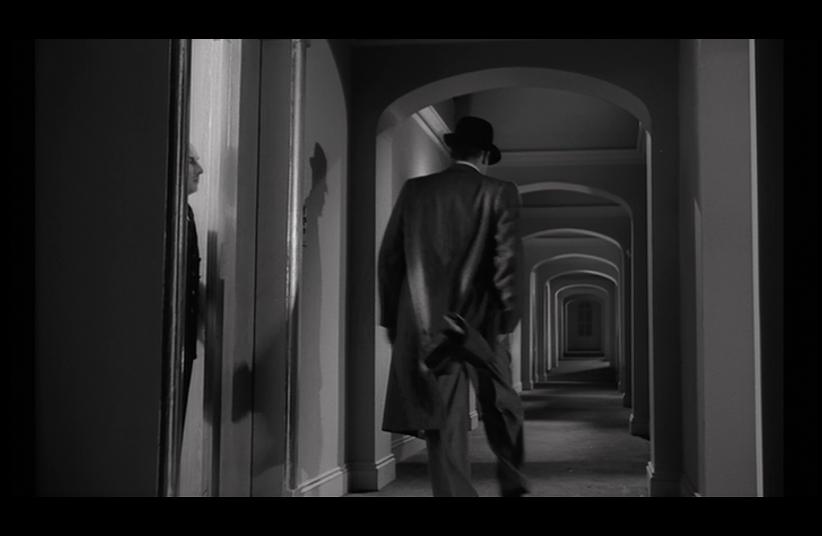
This is not to discount Lewin's hand in the visuals. Lewin directs with a painter's eye; he has the ability to wed small details to strong, dynamic lines. Look back to that still of the musician leaning up against the statue, the line of his trombone against the diagonal of the column. Or the one of Mason being held by guards as the floor pattern stretches beyond him to infinity. Actually most of the Dutchman's backstory is cleverly photographed by Lewin and Cardiff to look like a series of Baroque paintings. Lewin wasn't afraid to reach for the obscure or the strange in his visual work and it works greatly to the film's advantage.
Pandora and the Flying Dutchman is a film about timeless passion, the kind that would make a man kill the wife he loves, that would make a faithless woman risk death. And it was a film driven by the passion of one man, Albert Lewin, who wrote, directed, and produced it. How odd then, that the film ultimately feels so empty of passion or feeling. Jack Cardiff's color cinematography is a gift from heaven, but that isn't enough to keep the fires burning. I watched it with clinical, Pandora-like detachment, all through the two-hour running length.
And yet, somehow I can't call it a waste of time. It's a strange mixture of the sublime and the dull. It reaches astonishing heights of beauty through Cardiff's colors, Lewin's compositions and Ava Gardner's genetics. But they're laid at the service of a self-important, humorless script and pacing that just plods along. Still, if Lewin doesn't succeed in making a masterpiece, he does create a memorable and utterly unique film. How can you help but tip your hat to Albert Lewin, the man of many dreams?
Favorite Quote:
"No work of art is complete until the element of chance is entered into it."
Favorite Scene:
The film's most magical moment comes when Pandora decides to swim to the Dutchman's empty ship. Leaving her bewildered companion behind on the crumbling steps, she slips out of her clothes into the shimmering blue water. When she reaches the ship, she calls out her hellos. Confident, as always, of her welcome. Confused at the lack of response, she swims to the side, peeking her head over and looking, for all the world, like a mermaid. Pandora looks in vain for crew members, but sees only the moonlight glinting off the railings and boards. But then, she sees a light from one doorway. Too curious to back down, Pandora wraps herself in a sail and looks through the window. She sees a man painting, his back to her. A normal woman would leave then and there, but Pandora isn't normal. She saunters through the doorway, only to find the painter, his back to her. He doesn't acknowledge her. She doesn't know what's happening, we don't know what's happening. And in that moment, the film vibrates on the edge of the extraordinary.
Final Six Words:
This sleeping beauty never wakes up
Note: Astute viewers will note that five of my screencaps come from the DVDBeaver website. Normally, I wouldn't use so many, but I did want to give a sense of Cardiff's visuals and on this occasion, I wasn't able to use my own screencaps.
directed by Albert Lewin, starring Ava Gardner, James Mason
Pandora Reynolds (Ava Gardner), a beautiful, bored singer, lives amongst the expatriates that flit along the European coastline in the 1930s. No man can resist Pandora's charms--one even commits suicide over her--but she remains unmoved. One night, one of her suitors (Nigel Patrick) decides to prove his love by pushing his beloved racing car off a cliff. Pandora is impressed by his sacrifice and agrees to marry him. In the words of her friend Geoffrey Fielding (Harold Warrender), "The measure of love is what one is willing to give up for it."
But fate has other plans for Pandora. On the night of her engagement, Pandora spots a yacht out in the harbor and impulsively swims out to it (stark naked). There she meets Hendrik van der Zee (James Mason), mysteriously the only man on board. He is completely unsurprised by her entrance, turning away from her so that he can finish painting a portrait. But when Pandora goes to look at the painting, she finds out that it looks exactly like her. How can that be, when she has never met this man, and he claims not to know her?
Intrigued, for probably the first time in her life, Pandora draws this mysterious stranger into her circle of friends. The attraction between Hendrik and Pandora is obvious to everyone, even as the date of Pandora's wedding draws closer. But Pandora's friend Geoffrey starts to suspect that there is something extraordinary about Hendrik van der Zee.
On a hunch, he asks Hendrik to translate an old Dutch manuscript for him. Hendrik obeys, reciting the dark, strange tale of a sea captain who killed his wife for her infidelity. Arrested for her murder, the captain swore to the heavens that no man could ever find a truly faithful woman, if he sailed the seas for all eternity. That night, the captain found his cell door unlocked and a voice whispered to him the truth: his wife had never been unfaithful. Heartbroken, the man stumbled back to his ship and discovered that it now sailed by itself, manned by a crew he could neither see nor hear. Soon, the captain discovered the true nature of his punishment: he would sail until the end of time, looking for a woman who loved him enough to die for him. Every seven years, he would be allowed to go ashore and spend six months there, looking for such a woman. If he did not find her, he would be cursed to wander, immortal and alone, forever.
The emotion in Hendrik's voice as he reads the story convinces Geoffrey that this is the very same sea captain, the Flying Dutchman of the story. He also suspects that the captain has fallen truly in love with Pandora, that she might be the one to rescue him from his bondage. But even if Pandora were willing to sacrifice herself, how could the Dutchman ever allow her to do it?
Albert Lewin, the man behind Pandora and the Flying Dutchman, was one of the most unusual directors to come out of mid-century filmmaking. He only directed six films, all of which he wrote and produced himself. In defiance of mainstream tastes, his films were erudite, highbrow, and fiercely intellectual. Lewin was also an art collector, with a taste for the surreal (his friends included Man Ray and Max Ernst) and his films frequently reflected this fascination. Pandora and the Flying Dutchman was his fourth film and many consider it the culmination of Lewin's obsessions: a proudly romantic, visually fascinating attempt to bring his love for myths and art to cinematic life.
Talk about an embarrassment of riches--Pandora and the Flying Dutchman might be considered an embarrassment of references. The film takes the original legend of the Flying Dutchman and combines it with the Greek legend of Pandora, the fabled "darling of the gods." The name of the village in which the film is set is Esperanza ("hope"), famously the only thing Pandora had left after she opened the box. And the Dutchman is given a backstory straight out of Othello, with a chance at redemption that hails from Heinrich Heine's classic opera.
Lewin threads the film with other, smaller details. The film opens with lines from the Rubaiyat. Hendrik the Dutchman recites Matthew Arnold's "Dover Beach" at one point. Hendrik's painting of Pandora is an actual painting by Man Ray, who also designed a chess set for the film. The cast roams over beaches strewn with broken statuary. This last detail leads to one of the film's more memorable setpieces, as a crowd of partygoers dance and laugh amidst the statues, the new merrily tramping all over the old. It's like a sequence straight out of La Dolce Vita.
As if to complicates matters further, Lewin sets the whole film back in the 1930s and then promptly disregards his chosen time period in order to dress his cast of expats in the latest fashions. The 1930s time period only makes sense as a reference to Hemingway and Fitzgerald's crowd. The way Lewin lingers over a car racing scene and a bullfighting sequence leaves little room for doubt that he had Hemingway in mind. Within this confusion of time and place, Lewin sets the impossible love story of the Dutchman and the nightclub singer.
Pandora and the Flying Dutchman is a film that announces from the very first scene that this will be an epic love story, a tale of delirious and sacrificial love that lasts beyond death. Unfortunately, all the delirium exists within Lewin's frenzy of art and myth; when it comes to the real emotional heart of the story, the film falters. The love story between Ava Gardner's Pandora and James Mason's Hendrik is incredibly, epically dull. How can such an ambitious film, beautifully lensed by the legendary Jack Cardiff, fail so miserably on its most important point?
Well for starters, Gardner and Mason have almost no chemistry together. But that's the least of the love story's problems. For reasons best known to himself, Albert Lewin decided to keep the development of Pandora and Hendrik's relationship mostly off-screen. We rack up more minutes on Hendrik's backstory and the shallow lives of Pandora's friends than we do on the lovers themselves. If not for a stray comment by Pandora's friend Geoffrey (who seems to exist for no other reason than to be our narrator, a kind of bargain basement Morgan Freeman), you would never know that Hendrik and Pandora were falling in love. The only hypothesis I can make for this is that Lewin thought the grandeur of their love was best left to the imagination. Unfortunately, this tactic means that the audience doesn't have any emotional stake in their love. We don't know what they talk about, what they're like together, or why they love each other.
In the few moments where they do interact with each other, Lewin saddles the actors with very flat, portentous dialogue. For example:
Hendrik: Perhaps you haven't found what you want yet, perhaps you're unfulfilled. Perhaps you don't even know what you want, perhaps you're discontented. Discontentment often finds vent through fury and destruction.
Pandora: Fury and destruction, is that what you think? Well perhaps I can find something here to destroy...Would you like me to destroy your painting?
Hendrik: If it would help to quiet your soul.
(a few lines later)
Pandora: You've made me feel ashamed of myself. It's a new emotion, I'm not sure I like it.
Here's another example:
These aren't characters talking, these are concepts. It makes me feel like the Robot Devil from Futurama. "You can't just have your characters announce how they feel! That makes me feel angry!" It's flat enough on paper, but in the mouths of actors it's just painful. What makes it even worse is that Lewin doesn't bother to leaven it with any humor or uncertainty. It's all formal declarations in tones of deadly seriousness. In his attempt to impress on us the importance of his ideas, Lewin bypasses both realism and poetry and comes up with something that's neither. Mason and Gardner do their best, but you can feel the wheels grinding.Pandora: It's as if everything that happened before I met you didn't happen to me at all but to someone else. And in a way that's true. I've changed so since I've known you. I'm not cruel and hateful as I used to be, hurting people because I was so unhappy myself. I know now what destructiveness comes from, it's a lack of love.
Ava Gardner is heart-stoppingly beautiful in this film; she seems to glow from every angle. It's her beauty more than anything that makes Pandora's La Belle Dame Sans Merci reputation seem utterly plausible. Who wouldn't be tempted to throw their racing car off a cliff for that face? Unfortunately her personality doesn't match up to her looks. Pandora the person is cold, distant, and callous; you have to wonder if her suitors ever bother to actually listen to anything she says. When one of her smitten gentlemen friends offs himself in her presence, Pandora's response is little more than a shrug ("Reggie was always talking about suicide...it's over now and I'm not sorry").
I can't help wondering, given Lewin's choice of setting, if he wasn't influenced by the Zelda Fitzgeralds and Duff Twysdens that haunt Jazz Age literature. If he was, he forgot to give his protagonist the charm and lust for life that made these women so unforgettable. It's bold of him to make his heroine so unlikable, but the expected payoff of the selfish Pandora being reformed by love isn't convincing. We aren't given any indication that Pandora has the deeper feelings that would make such a transformation possible.
James Mason fares somewhat better than Gardner if only because he can deliver Lewin's granite-faced dialogue with complete conviction. Hendrik van der Zee is a man out of his time, haunted by past regrets. He is drawn to Pandora, but his tormented face and demeanor don't exactly fit in with her party-loving crowd. Faced with both long stretches of exposition and long stretches of silent glowering, Mason does both admirably.
It's funny, though. Mason cut his teeth on dark, romantic roles (the Gainsborough melodramas and his string of Ophuls films come to mind). If anybody could unlock the swoon-worthy, Gothic-hero potential in Hendrik van der Zee, you'd think Mason could. Instead, he comes across as rather stiff and remote. Lines like, "I was angry once, I can never be angry again," make him seem less like Heathcliff and more like Bruce Banner. If the studio executives were hoping they could market this film on Mason's appeal to women, then this was a serious misfire.
With all the charges I've laid against Pandora and the Flying Dutchman, what could redeem it? Answer: the visuals. This is one of the most stunning Technicolor films I've ever seen. The nighttime scenes glow sapphire blue, purely unreal, while the daytime colors blaze hot. The shadows soften the actor's faces until they seem to shimmer in and out of the fantasy dreamscape that Jack Cardiff crafts from the Spanish coast. Cardiff's cinematography here could stand up alongside any of the films he made with Powell and Pressburger. And when you consider that Cardiff helmed both the on-location photography of Pandora and the Flying Dutchman and the largely setbound camerawork of Black Narcissus, well, the time has come to throw up your hands and declare Jack Cardiff the master of all.
This is not to discount Lewin's hand in the visuals. Lewin directs with a painter's eye; he has the ability to wed small details to strong, dynamic lines. Look back to that still of the musician leaning up against the statue, the line of his trombone against the diagonal of the column. Or the one of Mason being held by guards as the floor pattern stretches beyond him to infinity. Actually most of the Dutchman's backstory is cleverly photographed by Lewin and Cardiff to look like a series of Baroque paintings. Lewin wasn't afraid to reach for the obscure or the strange in his visual work and it works greatly to the film's advantage.
Pandora and the Flying Dutchman is a film about timeless passion, the kind that would make a man kill the wife he loves, that would make a faithless woman risk death. And it was a film driven by the passion of one man, Albert Lewin, who wrote, directed, and produced it. How odd then, that the film ultimately feels so empty of passion or feeling. Jack Cardiff's color cinematography is a gift from heaven, but that isn't enough to keep the fires burning. I watched it with clinical, Pandora-like detachment, all through the two-hour running length.
And yet, somehow I can't call it a waste of time. It's a strange mixture of the sublime and the dull. It reaches astonishing heights of beauty through Cardiff's colors, Lewin's compositions and Ava Gardner's genetics. But they're laid at the service of a self-important, humorless script and pacing that just plods along. Still, if Lewin doesn't succeed in making a masterpiece, he does create a memorable and utterly unique film. How can you help but tip your hat to Albert Lewin, the man of many dreams?
Favorite Quote:
"No work of art is complete until the element of chance is entered into it."
Favorite Scene:
The film's most magical moment comes when Pandora decides to swim to the Dutchman's empty ship. Leaving her bewildered companion behind on the crumbling steps, she slips out of her clothes into the shimmering blue water. When she reaches the ship, she calls out her hellos. Confident, as always, of her welcome. Confused at the lack of response, she swims to the side, peeking her head over and looking, for all the world, like a mermaid. Pandora looks in vain for crew members, but sees only the moonlight glinting off the railings and boards. But then, she sees a light from one doorway. Too curious to back down, Pandora wraps herself in a sail and looks through the window. She sees a man painting, his back to her. A normal woman would leave then and there, but Pandora isn't normal. She saunters through the doorway, only to find the painter, his back to her. He doesn't acknowledge her. She doesn't know what's happening, we don't know what's happening. And in that moment, the film vibrates on the edge of the extraordinary.
Final Six Words:
This sleeping beauty never wakes up
Note: Astute viewers will note that five of my screencaps come from the DVDBeaver website. Normally, I wouldn't use so many, but I did want to give a sense of Cardiff's visuals and on this occasion, I wasn't able to use my own screencaps.
Labels:
1951,
Albert Lewin,
Ava Gardner,
British film,
drama,
fantasy,
film reviews,
Jack Cardiff,
James Mason
Friday, August 12, 2011
Dance of the Seven Blogathons
Is it just me or is the summer just racing by? It seems like only yesterday, I was posting on my "Blogathon Round-Up" and now, I'm back with even more blogathon updates. The floodgates have opened and now everyone's getting in the blogathon spirit. I'm almost tempted to hold one myself...nah, I think I'll hold that thought. I'm really excited about some of the upcoming events and I hope my readers will be tempted to sign up for at least one of them. C'mon, Rita Hayworth would want you to!
Blogathons Past But Not Forgotten
The Monster Mash Blogathon (July 28th-August 2nd 2011), Hosted by Nathanael at Forgotten Classics of Yesteryear
"Now...some of you may be thinking that monster movies aren't worth your time...that monster movies were never good. You'd be WRONG. Monster movies in the 50s were some of the most interpretively rich in film history. Monsters represented everything from fears concerning Communism...nuclear radiation....to...whatever the hell this is."
(Note: I do want to slip in here briefly and say thanks to everybody again, for your enthusiastic response to my Night of the Demon Review. To co-opt Lee Marvin's Oscar speech, I think half of my award belongs to a demon somewhere out there in the British countryside.)
The Lucille Ball Blogathon (August 6th, 2011), Hosted by Brandie, Carrie, and Nikki at True Classics
"We called it the “Loving Lucy” blogathon because the act of loving Lucy is something that comes almost as naturally as breathing to those of us who’ve been touched by her work. We love her for the way she makes us laugh, the way she makes us empathize with her … even the way she makes us cry. She was gorgeous and genuine and strong and relatable. She shared her gift with the world and, in the process, made the world a more beautiful place simply for her having been in it."
What else is there to say about Lucille Ball? Well, as it turns out, quite a lot. This was one hell of a blogathon; the outpouring of love and admiration for America's one true redhead was a sight to see. Brandie, Carrie, and Nikki did an incredible hosting job and the bloggers responded with some great, great writing.
Blogathons of the Near Future
The Nicholas Ray Blogathon (September 5th-8th, 2011), Hosted by Tony Dayoub at the Cinema Viewfinder
"I'd like to invite anyone and everyone to participate in my third annual Labor Day blogathon, running September 5 - 8. In years past many contributors have made this annual tradition a resounding success, first in 2009 when we celebrated the work of Brian De Palma and last year when we praised David Cronenberg. This year's featured director, Nicholas Ray, would have celebrated his centennial today. First recognized by the auteurists who launched the French New Wave, Ray's body of work is one of the most influential in all of cinema."Judging by Cinema Viewfinder's past blogathons, I predict this one will be a real firecracker. And considering the subject and his work (a career that included Bigger than Life, Rebel Without a Cause, Johnny Guitar, In a Lonely Place, They Live By Night), I'm really looking forward to it.
The Margaret Lockwood 95th Birthday Blogathon (September 15th, 2011), Hosted by Mercurie at A Shroud of Thoughts
"15 September 2011 will be be the 95th birthday of legendary British actress Margaret Lockwood CBE. Miss Lockwood appeared in such classic films as The Lady Vanishes (1938), Night Train to Munich (1940), and The Wicked Lady (1945). On television she was the star of the Yorkshire Television series Justice, which ran from 1971 to 1974. Given Miss Lockwood's position in British film and television, I thought it would be fitting to hold a blogathon in honour of her 95th birthday."I've long had a soft spot for Margaret Lockwood. She was one of Hitchcock's most charming heroines (and a brunette to boot) in The Lady Vanishes and she played the wicked stepmother in one of my childhood favorites, The Slipper and the Rose. But that's only a small part of this talented actress's career. I'm hoping a lot of people go sign up for this one.
The Fashion in Film Blogathon (September 24th, 2011), Hosted by Angela at the Hollywood Revue
"On Saturday, September 24th, I would like to host a Fashion in Film blogathon! I’m looking for articles on:
Anything else you can think of that deals with movie costumes and design is also welcome. Even though this is a classic film blog, bloggers who write about modern movies are absolutely welcome and encouraged to join in! "
- Costume designers
- Costumes in a particular movie
- Movies that influenced the way people dress
- Actresses who became style icons because of their movie wardrobes
- Analyses of what a character’s wardrobe says about who they are (I recommend checking out Tom and Lorenzo’s Mad Style articles for inspiration on that).
As my more frequent readers could guess, I love talking about costume on film; lack of expertise never stops me. So the thought of a whole blogathon on the subject makes me feel like doing a Snoopy Dance. Go forth and write, bloggers, in the names of Adrian and Edith Head and Givenchy and Orry-Kelly! In the names of Walter Plunkett, Jean Louis, Charles LeMaire and Helen Rose! And for so many others.
The Dick Van Dyke Show Blogathon (October 3rd, 2011), Hosted by Ivan G. Shreve of the Thrilling Days of Yesteryear
"October 3, 2011 will mark the fiftieth birthday of the debut of The Dick Van Dyke Show, and while I’ve already been tapped to do a write-up at ECOF....I decided to go the extra mile and see if this might not be the perfect vehicle for TDOY’s very first blogathon. The Dick Van Dyke Show is my favorite situation comedy of all time, hands down—and so I’m pleased as the proverbial Hawaiian Punch to announce that Thrilling Days of Yesteryear is going to host a ‘thon in honor of this timeless classic."Ivan's long been one of the best and most tireless bloggers around; whenever I see his name on a list of blogathon contributors, I know he's going to have something good. So when I heard that he was hosting his own blogathon, I immediately jumped at the chance to write up an entry. Whether you grew up watching The Dick Van Dyke Show or Diagnosis: Murder or Mary Poppins, you owe it to yourself to at least stop by Ivan's blog on October 3rd. Let's throw some confetti for Rob and Laura Petrie! And for Dick Van Dyke and Mary Tyler Moore, one of television's best onscreen couples.
The Carole Lombard Blogathon, also known as The Carole-tennial (+3) (October 6th-9th, 2011), Hosted by Vincent at at Carole-and-Co Livejournal
Considering Carole Lombard could still quite handily win a popularity contest amongst classic film buffs, it's kind of amazing that it's taken this long for a major blogathon in her honor. Unless there was one and I was busy sorting my stamp collection that day. No matter, Carole will have her party! Let's all put aside our knitting and our golf clubs and our term papers to pay homage to the First Lady of Screwball Comedy. The queen of our hearts."The big news is this: "Carole & Co." is planning its first-ever blogathon! We're calling it the "Carole-tennial(+3)" in honor of the 103rd anniversary of Lombard's birth Oct. 6. This year, that date falls on a Thursday, so to give everyone an opportunity to contribute, the blogathon will run from Oct. 6 to Sunday, Oct. 9."
Whew! That's a pretty full blogathon schedule! For my sanity, people, please don't rush out and announce an Alfred Hitchock or a Gloria Grahame blogathon tomorrow, I can't keep up with it. Nevertheless, blogathons are my Internet ice cream and I think we've got a lot to look forward to in the coming months. In these troubled times, let us unite over our love of Lombard and Lockwood, of Ray and robot monsters, of Dick and Lucy and Scarlett O'Hara's crinolines.
Second Hayworth picture credited to VintageGal
Monday, August 8, 2011
Like a Junkie Shooting Pure Quicksilver Into His Veins--The Liebster Award
"Like a junkie shooting pure quicksilver into his veins, Frankie Rachel got turned on by the wildest narcotic known to man: success!"
I have to admit that I'm unfamiliar with the history of this particular award (other than the fact that it means "beloved"), but it's been circulating for the past few days. There are two official rules. I must link back to the blog that gave me the award (already done and happily so). And I must now send the Liebster Award to 5 other blogs that I consider worthy of the honor.
Before I name my 5 blogs, I do want to make it clear that my awards are meant in good fun and in the spirit of spreading love. For me personally, I like telling people about the blogs I enjoy and so, I consider this an opportunity to share my enthusiasm. I understand that some people prefer not to mess with these blogging awards, for various reasons, and I'll respect it if you'd rather not accept the award. Also, please forgive me if I accidentally award someone who's already received one. Consider yourself doubly blessed.
And now for my five honorees. Believe me, it was a tough decision.
Who Can Turn the World Off With Her Smile? Laura is one of the more versatile bloggers I know. Who else can go from a heartfelt explanation of why the Mummy is the most romantic movie monster to an exploration of early Vivien Leigh to an in-depth analysis of the Joker? I love that when I go to her blog, I'm never sure what to expect. Except that I know it'll give me something to think about when I leave.
Immortal Ephemera Every so often, I say to myself, "You know what's awesome? Cliff over at Immortal Ephemera, that's what's awesome!" He's incredibly knowledgeable about all things classic-film related (as well as many things that aren't) and his treasury of memorabilia is amazing. Added to that, he's always willing to strike up a friendly conversation.
All Good Things I was glued to Monty's Classic Movie Actor Tournament this summer and I would occasionally come up to my friends with random non sequiturs like, "Hah, did you know that Alec Guinness is beating Marlon Brando?" (They were very confused, I must say.) But aside from that, Monty's blog is a haven for sharing enthusiasm over stars of the past and the films that made them great. It's like hot chocolate in blog form.
50 Westerns from the 50s I haven't really gotten around to discussing Westerns much on this blog. I do watch them, I swear. But it's lucky I have Toby's fine blog around to remind me of the many treasures to be found in the genre, as well as some of its more oddball offerings. Whether you love Westerns or hate them, you have to stop by this blog.
Comet Over Hollywood Where else could I find out the secret beauty tips of Bette Davis and Katharine Hepburn? But aside from old-school Hollywood glamor, Jnpickens is a thoughtful and sympathetic writer, always willing to dig through gossip and rumor without getting mired down in it. That's a rare gift, no matter what you're writing about.
"Bye, Frankie Rachel! And I hope the Oscar Liebster Award keeps you warm on cold nights!"
Well, Elke Sommer, maybe it won't. But who could feel cold with such wonderful bloggers around? This is Rachel, signing off.
My apologies for all the shameless references to The Oscar. But hey, would you pass up the chance to quote from that movie?
Saturday, July 30, 2011
Movie Review: Night of the Demon/Curse of the Demon
Night of the Demon/Curse of the Demon* (1957)
directed by Jacques Tourneur, starring Dana Andrews, Peggy Cummins, Niall MacGinnis
*Night of the Demon was the original British title. For the American release, the film was edited and re-titled Curse of the Demon. For clarity's sake, I'll refer to the film in my review as Night of the Demon since I chose to view the original, uncut British version.
(Note: This is my entry for the '50s Monster Mash Blogathon, hosted by Forgotten Classics of Yesteryear.)
The renowned Dr. John Holden (Dana Andrews), an expert on hypnotism and superstition, flies to England to attend a symposium on the supernatural. Holden plans to participate in an investigation of a mysterious devil-worshiping cult and their eccentric leader Julian Karswell (Niall MacGinnis). However, when Holden arrives, he finds out that one of his colleagues, Professor Harrington (Maurice Denham), has died under mysterious circumstances. Karswell appears to Holden and warns him away from proceeding with the investigation, but Holden laughs it off. His skepticism is challenged by the arrival of Joanna Harrington (Peggy Cummins), Professor Harrington's niece, who believes her uncle was killed by something supernatural, something to do with Karswell's cult. The two team up to find out the truth.
Holden refuses to admit the existence of the supernatural, but how does he explain the strange events happening around them? Why does he feels chilled when the weather is hot, why does he see visions of living smoke, and how does Karswell appear to summon wind storms and wild cats? Holden is further puzzled by finding a scrap of paper slipped in amongst his things, with runic inscriptions on it. Holden and Joanna discover that Professor Harrington received a similar paper, three days before he died. With the furtive help of Karswell's elderly mother, (Athene Seyler), the pair find evidence to suggest that Holden too is doomed to die in three days. Unless he can find out the secret of the runes before it's too late. Before he is caught by Karswell's curse. The curse of the demon.
Night of the Demon was based on M.R. James' classic story, "The Casting of the Runes," often acclaimed as one of the greatest scary stories of all time. In James' original tale, the focus was on a mild-mannered academic named Dunning, who becomes the target of the mad and bad Mr. Karswell, after Dunning rejects Karswell's rather incoherent paper on alchemy. Mysterious things begin to happen to Dunning. He sees cryptic messages, he feels nervous all the time, his servants mysteriously develop poisoning symptoms. It's only after he encounters John Harrington, brother of the late Henry Harrington, that he begins to understand what happens to the enemies of Mr. Karswell. And what may happen to him. The power of James' story comes from the dry, understated way these unsettling details begin to pile up, the way the darkness peeks out between the cracks of the maddeningly deliberate prose.
Jacques Tourneur's film takes this story and manages to craft a great horror film that honors its original source material while managing to deepen and enrich the story's themes. Night of the Demon changes the protagonist from a conventional British academic to a hard-headed American scientist named John Holden, whose journey to England results in a clash not just of culture, but of science against superstition. As one of his colleagues tells him, "Take it kind of easy on our ghosts. We English are sort of fond of them." The John Harrington of the story becomes Joanna Harrington, the niece of the mysteriously dead Professor Harrington. She helps Holden try to uncover the mystery of Mr. Karswell, who has been promoted from the frustrated academic of the James story into a powerful cult leader. James' story clung to the ordinary trappings of English life; the action was confined to railway cars, hotels, and small private rooms. Tourneur's film ranges all over, taking Holden from apartment buildings to isolated farmhouses to a spooky manor house, even to Stonehenge. And unlike the original story, which plays as an exercise in "is it or isn't it," Night of the Demon boldly opens with the gambit of actually showing the reality of its supernatural threat, as personified by the demon.
The question of the demon has plagued fans of this film since the very beginning. There is one camp, let's call them Anti-Demon, who swear up and down that Jacques Tourneur never planned to actually show the demon in the movie and that its actual appearance is a serious letdown from a subtle psychological horror film. For the record, Tourneur himself was in the Anti-Demon camp and remarked in interviews that the creature's appearance was forced on him by producer Hal E. Chester. But there's also a Pro-Demon camp, who insist that the demon is genuinely frightening and that the movie wouldn't be nearly as satisfying without it. Author Tony Earnshaw, in his book Beating the Devil: The Making of the Night of the Demon, claims that the demon's appearance was planned from early on, rather than shoehorned in at the last minute.
For myself, I have to stand in the Anti-Demon camp. It isn't because I think the monster shouldn't have been shown, it's because of how it's shown. At first when we see the demon, it always appears from a distance, shrouded in smoke and slightly blurry, so that it could be mistaken for an illusion. In those moments, it's genuinely unsettling, this strange black something that's coming closer and closer. Tourneur, quite craftily, always places the demon in settings where its appearance echoes something more ordinary. There's not much difference between a monster and the flash and smoke of an oncoming train. Or much difference between a demon and the sparks of a crashing telegraph pole.
It's only when the film suddenly zooms into a close-up of our monster, as in the still above, that all mystery vanishes and it becomes just another '50s movie monster. And it's not bad by '50s movie monster standards, it's just that it seems so out of place with the almost subliminal glimpses we were getting before. There's one lingering shot of the demon shaking a man like a rag doll that veers straight into comedy. It doesn't feel organic to the film, it feels like a money shot, like the filmmakers are telling us we got our money's worth in special effects horror. There's a similarly silly moment earlier in the film, when Dana Andrews is attacked by a cat that morphs into a leopard (call-back to Lewton and Tourneur's Cat People?) and the camera lingers long enough for us to realize that Andrews is fighting a stuffed cat. And I think these problems aren't because of bad special effects (Modern CGI would be just as much of a let-down), it's because these shots don't fit with an otherwise suggestive film. Night of the Demon ends on the words, "Maybe it's better not to know," and in this case, the film should have taken its own advice.
That complaint over with, I am free to linger over the many strengths of this film. Aside from the demon itself, Night of the Demon's production design is gorgeous; each set we see is carefully detailed and feels exactly right for the character that inhabits it. The strange geometrics of Karswell's mansion with its spiral staircases, Holden's cramped apartment, Joanna's striped wallpaper in the firelight, it's all fantastic. I kept wanting to pause the movie to linger over the details and I'm sure there are worse ways to spend an afternoon than in trying to parse the visuals of this film.
Jacques Tourneur's direction here is on par with his best work. Night of the Demon creates a mesmerizing, disquieting world, in which every shot seems designed to constrict your breathing. You can spot a lesser horror film by the way the movie deflates in between shock moments, as if the director doesn't know what to do when there's no big scary thing to shake in your face. Here though, Tourneur never loosens his grip. The echoing corridors, the barren countrysides, everything reflects back the fear and paranoia that slowly begins to grip our protagonists. Even a library becomes a horrifying labyrinth straight out of Crete. Tourneur mainly eschews "gotcha" tricks in favor of a suffocating sense of unease that occasionally veers into the hallucinatory. The way Holden's point-of-view sometimes blurs; is it a sign that he's losing his hold on reality? The way a hand appears on a balustrade, seemingly out of nowhere. In Night of the Demon, there's no easy distinction between the ordinary and the supernatural. They exist together.
At this point in his career, Dana Andrews was very much a sideliner, his alcoholism having relegated him to B-parts. In her brilliant essay on the career of the fascinating and vastly underrated Andrews, Imogen Sara Smith writes, concerning his work in Night of the Demon, that "the slur in his voice and uneasiness in his manner make him intriguing in a role that could have been played by Kent Smith." There was always that unease to Andrews, that lurking discomfort underneath the surface, so it's interesting here to see him play a character who is so determined not to look beneath the surface. The hyper-rationalist character of John Holden is, in fact, so stubborn, so smug and self-assured, that the film's sympathy often shifts away from him to the side characters. Even a group of daffy seance-seekers singing "Cherry Ripe" seem more reasonable. It's only by admitting his fears and doubts, however, that Holden can find a way to fight Karswell. And their battle of wits is something to see, indeed.
It's always a treat to see the talented Peggy Cummins although she doesn't really get to stretch herself as the "horribly bright" Joanna Harrington. Joanna, the professor's niece, is a bit of a stock character. B-movie scientists always seem to have a surplus of beautiful nieces/daughters/granddaughters that pop up out of nowhere, carrying research notes and ready to risk their lives. Still, Cummins adds some spark to the character and Joanna's willingness to accept the supernatural is the necessary foil to Holden's skepticism. Her best moment is when she snaps at the perpetually condescending Holden, "Please don't treat me like a mental patient who has to be humored. I also majored in psychology."
But the real treasure of this cast is Niall MacGinnis as the charming but sinister Julian Karswell. I don't think I'm exaggerating when I say that this has to be one of the great horror movie villains of all time. At first glance, he's like a cross between Clarence the Angel and Mephistopheles. He threatens, but with a smile and a joke. He's fond of children and his mother, but he also summons demons from hell. He seems confident in his dark powers but to his mother, he confesses the terrible cycle he's caught in. "My followers who pay for this do it out of fear. And I do what I do out of fear also. It's part of the price." Unlike the Karswell of the original short story, a "horrible man" who combines the evils of devil worship with the evils of badly written papers and whose only actions are malignant and petty, the movie Karswell is more fascinating. He's unpredictable, which makes him all the more powerful as an enemy. But there's also a shred of sympathy for his character, who must continually find new victims or else become a victim himself. Ironically, our hero Holden has to find that same ruthlessness within himself by the finale, if he plans to survive.
It's hard to write a review for a film like this without feeling you've only barely scraped at the surface; it's just that fascinating. You could watch it solely for the beauty of Tourneur's visuals. Or you could watch it for the sly humor of Charles Bennett's script. Or for the moment when Dana Andrews stands next to Stonehenge, utterly dwarfed by the mysteries he knows not. Or watch it so that you and your friends can have a rousing debate of Pro-Demon/Anti-Demon. It's a fine horror film and eminently worthy of its cult status.
Favorite Quote:
"How can you give back life? I can't stop it. I can't give it back. I can't let anyone destroy this thing. I must protect myself. Because if it's not someone else's life, it'll be mine. Do you understand, Mother? It'll be mine."
Favorite Scene:
For my money, the party scene at Karswell's house is just about perfect. Holden and Joanna go to Karswell's property to question him and are taken aback by the luxury and size of the place, hardly appropriate for the home of some crackpot con artist. And when they find Karswell, what is this master of dark magic doing? Why, he's dressed up as a clown and doing magic tricks for the local children ("A magic puppy! Now, who'd like to stroke a magic puppy?"). And his mother's even making ice cream. This is one instance of the film completely reversing a scene from the original story. In "Casting the Runes," Karswell is a sadist, who gives the local children a gruesome slide show in order to terrify them. Here, Karswell is genuinely sweet to them, which makes the underlying menace of his character all the more interesting. As he and Holden pass by a pair of kids playing a game of Snakes and Ladders, Karswell remarks whimsically that he always preferred sliding down the snakes to climbing up ladders. Holden responds that maybe it means Karswell's a good loser. Karswell turns to him, coldly serious. "I'm not, you know. Not a bit of it."
Final Six Words:
It's in the trees! It's coming!
Labels:
1957,
blogathons,
British film,
Dana Andrews,
film reviews,
horror,
Jacques Tourneur,
Peggy Cummins
Wednesday, July 20, 2011
Tough Guy Names
So I was reading Tom Shone's post about the reported return of Kevin Costner's dark side in Django Unchained and suddenly I was filled with joy and anticipation. Not because Costner is acting again but because he would be playing the character of Ace Woody. If there's one thing that current cinema is missing, it's tough guy names like Ace Woody. And that got me thinking about the many Golden Age films (mainly Westerns and Warner Bros. flicks) that weren't afraid to name their heroes things like Cole Harden. I miss that. Here's hoping that Tarantino can bring the tradition back.
And now, here's a sample of Golden Age actors and their manly, manly names:
Cole Harden in The Westerner
Blayde Hollister in Dallas
Ace Wilfong in A Free Soul
Big John McMasters in Boom Town
Whip McCord in The Oklahoma Kid
Gloves Donahue in All Through the Night
Rip Murdock in Dark Reckoning
Dixon Steele in In a Lonely Place
John Wayne
Duke Slade in Adventure's End
Wedge Donovan in The Fighting Seabees
Chance Buckman in Hellfighters
Randolph Scott
Brazos Kane in Gunfighters
Ransome Callicut in The Man Behind the Gun
Buck Devlin in Shoot-Out at Medicine Bend
Ben Brigade in Ride Lonesome
Alan Ladd
Salty O'Rourke in Salty O'Rourke
Whispering Smith in Whispering Smith
Hugh Tallant in Botany Bay
Ronald Reagan
Brass Bancroft in Secret Service of the Air, Code of the Secret Service, Smashing the Money Ring, and Murder in the Air
Vance Britten in The Last Outpost
Webb Sloane in Prisoner of War
Subscribe to:
Posts (Atom)