Sunday, September 22, 2013

Movie Review: Scandal Sheet


Scandal Sheet (1952)
directed by Phil Karlson, starring Broderick Crawford, John Derek

Note: This is my entry in the Journalism in Classic Film Blogathon, hosted by Comet Over Hollywood and Lindsay's Movie Musings

Once upon a time, the Daily Express was a respectable newspaper. In the hands of the unscrupulous editor Mark Chapman (Broderick Crawford), it's devolved into little more than a tabloid, with headlines like "Police Seek Gorilla Man-Slayer." Honor and prestige don't matter much to Chapman though, so long as circulation keeps rising. His star reporter Steve McCleary (John Derek) is a chip off the old block, resorting to tricks and lies to get the best headlines. Columnist Julie Allison (Donna Reed) is appalled at Chapman and McCleary's tactics but her objections are always steamrollered.

But Chapman's latest gag will wind up tying a noose around his neck. At a Lonelyhearts Ball sponsored by the Daily Express, a woman (Rosemary DeCamp) approaches Chapman with news that could break his career. She's the wife he abandoned twenty years ago and she's going to let the whole world know what a crook he is. They struggle and Chapman accidentally kills her. He covers up the crime, but he doesn't reckon on just how well he trained his protege McCleary. The young man is convinced that the Lonelyhearts Murder will be the story of his career and he's determined to sniff out every possible lead. Now Chapman is caught in a game of keeping McCleary off his trail without drawing suspicion. He's got to keep this story buried...no matter who he has to bury along with it.


One of my high school English teachers used to quote from a text that said detectives are the most natural heroes of a story because they want the same thing the reader wants: to know what's going on. The same thing could be said for fictional reporters with one crucial difference. It's the reporter's job to tell the truth, to broadcast it and sell it. A fictional detective can uncover the murderer and go home to tea and biscuits, satisfied that his work is done. The reporter always has to make a choice in how the information is used. It's a distinction that makes the reporter equally adept in the role of villain or hero. Things will never be clear-cut for them. There will always be consequences. There will always be one eye on the profit margin. No wonder reporters are always such cynics in the movies.

Scandal Sheet takes a basic but irresistible premise: what if the reporter was the one who committed the crime? And what if he had to make it look like he wanted to uncover the truth, even while doing everything possible to conceal it? The movie raises the stakes even further by pitting the villainous protagonist against his own protege, a man who'll do anything to get the story because that's what his boss taught him. The irony is that the investigation begins to turn the selfish younger reporter into a more principled man just as his mentor keeps sinking further into evil.


The movie was adapted from a novel by Samuel Fuller, the same Fuller that went on to direct Pickup on South Street and Shock Corridor. Before he went into movies, he was in journalism, starting work as a crime reporter at the age of 17. His experiences gave him a perfect insight into the workings of a journalist's world and he would return to the theme many times, from the obsessive, ambitious protagonist of Shock Corridor, convinced he'll win the Pulitzer to the dedicated, idealistic reporters of Park Row (Fuller's own favorite film). Fuller unfortunately did not adapt the screenplay for Scandal Sheet nor did he direct; it would have been a real pleasure to see Fuller's gritty, chaotic take on the misfits that live on the edges of scandal rags. Few noir directors had Fuller's affection for the sleazy and grimy back alleys of the city or his ability to characterize its twisted inhabitants without condescension. The only one I can compare him to is Jules Dassin but Dassin was always more elegant and broadly humanistic in his approach. Fuller is messy and eccentric and that's what makes his style so fun.

But if we can't have Fuller, director Phil Karlson is no slouch either. In fact, he's probably the film's biggest asset. Karlson's greatest gifts were pacing and control; his movies transition smoothly from scenes of talk to scenes of brutal shocking violence in a way that leaves you dizzy. His masterpiece The Phenix City Story is a prime example, slowly upping the ante with each killing and somehow managing to make each one a sadistic surprise. Here, he stages the initial killing with a striking shot of Chapman's wife moving around him, her voice rising to a shriek as she threatens him with the destruction of everything he's worked for. Karlson's camera follows her in a circle, as if the woman is literally walking in the shape of a noose. When she and Chapman begin to struggle, it feels truly violent, with the wife digging her nails into the man's hair. The fight ends with her cracking her head on a pipe and Karlson lingers on the agonized expression of her face.


Even better is Chapman's later killing of an innocent, alcoholic former reporter (Henry O'Neill). The man knows too much and can't be allowed to live. Another director might have framed the scene to allow Broderick Crawford's threatening bulk to overwhelm the older O'Neill. Karlson keeps them in a merciless extreme closeup, cutting between Crawford's shadowed face and O'Neill's immediate awareness of his own death. The faces tell the whole story.

Faces are a constant visual theme in Scandal Sheet. Karlson keeps returning to extreme closeups throughout the film, allowing scenes to play out through the changing expressions of the actors. He also collects interesting faces to populate the film, from the beaten-down but elaborately made-up former wife (Rosemary DeCamp) to the pop-eyed drunk that comes with information. One of the more striking shots of the movie is a scene where McCleary goes to question the local alcoholics and Karlson lets the camera travel slowly down the bar, letting us look closely at each man's face, seeing the wrinkles and shadows and disappointments that make up these men's lives. That single shot tells us so much about how society and the glib McCleary view these men, while letting us see the barhounds' grim humanity. The whole movie in fact, hinges on people's ability to remember faces. It's that which trips Chapman up and it's his fatal flaw. He's so focused on circulation numbers and suckers and slobs that he can never truly see the faces, only the figures.


I've had an allergy to Broderick Crawford since Born Yesterday. His one-note, blustery, growly performance and lack of comic timing just dragged scene after scene through the cement mixer. Thankfully, Scandal Sheet asks him to play it cool and contained so the shouting is kept to a minimum here. As the editor and unwilling murderer Mark Chapman, Crawford is gruff but professional, careful to keep his frustrations under wraps. He conveys the man's growing panic mostly through the eyes, his gaze shifting away just a little too fast when someone tries to bring up a new angle on the Lonelyhearts Murder. Chapman ends up as the embodiment of "win-at-all-costs" journalism, a man whose disregard for the human beings behind the circulation numbers will be his undoing. Complete scum but Crawford finds a note of pathos in the man's ultimate fate.

What Crawford can't convey, however, is the kind of sleazy charisma that elevated other "evil journalist" films like Sweet Smell of Success and Ace in the Hole. Burt Lancaster and Kirk Douglas were black of heart but nobody could doubt their smarts, the pleasure they took in working over the masses. They were con man, but you couldn't help admiring their style. Broderick Crawford has bull-headed determination on his side, but no allure. This really deadens the impact of the film's central relationship; the one between Chapman and his slick, admiring protege McCleary. Crawford just doesn't seem believable as the object of someone's hero worship. Put someone like Robert Ryan in his place and it would make more sense.


John Derek's performance as Steve McCleary has the opposite problem. While Crawford's performance only really becomes great at the end, Derek's only really great in the beginning. He's perfectly suited as the callow reporter, so convinced of his charm and appeal that he can hustle Donna Reed into buying him dinner and dismiss her in the same breath. Derek's long lashes and skinny good looks seem bizarrely contemporary for a mid-century film; he's almost drowning in the heavy overcoats of the period. You could CGI him into any random CW show today and he'd fit right in. Still, the man carries off McCleary's fast-paced dialogue and smug reactions well; it's like watching a man bang around in a sports car, not even realizing how much he's scratching up the paint job. Derek's on shakier ground when McCleary has to discover sincerity. The movie doesn't set up any great chemistry between him and Crawford and Derek can't supply the emotional depth on his own. You imagine something like the relationship between Edward G. Robinson and Fred MacMurray in Double Indemnity and Scandal Sheet could have been a great film.


But if I'm faulting the movie for not achieving greatness, that's only because it so often seems close to getting there. The screenplay crackles with the kind of sharp, zinging lines that's essential to any great newspaper movie. "Don't count your steaks before you hear the sizzle." "I always said you were born in a field of shamrocks." "You're still too big for Dead End Street." "Does the judge's needle sew anything up?" "Everything but knotting the thread at the end...I mean the noose." The movie is full of clever details that add greatly to the atmosphere and themes. For example, The Lonelyhearts Ball lures couples to the altar with the promise of a bed with a built-in television set (oh great shades of the reality shows to come). The newspaper office is overshadowed by a giant clock that marks the rising circulation numbers. The numbers grow with the Lonelyhearts Murder Coverage, just as Chapman's time starts to run out. There's a lot of creativity and a lot of intelligence at work here. Ultimately the movie ends up as a good, sharp noir that promises a little more than it can deliver. But then, every journalist knows that it's not just the story. It's how you tell it. And Scandal Sheet does a fine job at that.


Favorite Quote:

"We got a new man on this beat that's built like you between the ears. He saw a hole in the back of the dame's skull and figured she was slugged." 

Favorite Scene:

The final confrontation. Karlson manages to take a climax that would be disappointingly basic, a simple case of a man remembering one crucial detail while the murderer foolishly hangs around rather than making a break for it, and makes it completely riveting. Everything plays out in tight closeups, with Broderick Crawford sliding in and out of the shadows. You can see his last shreds of hope warring with his fear as he tries, futilely, to hide his too-famous face from view. All while his protege slowly comes to realize that the man he's idolized has been a stranger all along. It's slow and suspenseful and finishes on a wickedly smart final image, a fitting riposte to the career of Mark Chapman, the man who traded in scandal.

Final Six Words:

Gives new meaning to "screaming headlines"

Friday, September 20, 2013

Random Blogging News


As random as Clint Eastwood holding an armadillo...

Before I get down to my reader's choice reviews (let me just say, the final results were...interesting) I thought it was high time I did a news post. Summer may be over but the movie bloggers aren't going to let it get them down. Every time I turn around, someone's posting a new blogathon. And it's looking like a particularly good crop this autumn. I'm a huge admirer of all the hosting blogs listed here and I'm so glad that they've decided to celebrate their personal movie passions. Please note that these blogathons all have open participation, so anybody who's interested can sign up.

Breaking News: Journalism in Classic Films Blogathon (Sept 21st-22nd), Hosted by Comet Over Hollywood and Lindsay's Movie Musings


This weekend, we go to the presses. It's a celebration of those crazy, committed people that live to bring you the latest headlines. Jessica from Comet Over Hollywood and Lindsay from Lindsay's Movie Musings are holding a blogathon to celebrate journalists in the movies. From Cary Grant and Rosalind Russell battling their way through His Girl Friday to the scheming, ruthless Kirk Douglas in Ace in the Hole, journalists have always been a rich topic for movies. Whether they're trying to uncover the truth or twist it for their own purposes, the reporters know where the action is. And this Saturday and Sunday, it's all about them.

The Great Imaginary Film Blogathon (Oct 1st-3rd), Hosted by the Metzinger Sisters at Silver Scenes


The Metzinger Sisters have been gracious enough to comment several times on this blog and I'm so happy they've decided to host their first blogathon. The Great Imaginary Film Blogathon is all about letting your imagination run wild. As they put it, "Here's your chance to gush about all those wonderful movies you wish were made but never were." Maybe you always wanted to see Wuthering Heights with Vivien Leigh in the lead (if you're anything like me that is). Maybe you want a Pre-Code adaptation of They Shoot Horses, Don't They? Maybe you just want to see William Powell play James Bond. In this blogathon, all these things can be yours. Follow the link to check out the possibilities.

The Hammer Halloween Blogathon (Oct 21st-25th), Hosted by the Classic Film and TV Cafe


Here, we take the opportunity to share Halloween with the people that made it the most stylish event of the year. The Classic Film and TV Cafe is hosting a celebration of classic Hammer Horror to usher in this year's Halloween festivities. That means Christopher Lee and Peter Cushing. It means Oliver Reed, Ingrid Pitt, Michael Gough, and Caroline Munro. Heaving bosoms, staircases, capes, fangs, claws, unspeakable evil, all the good things that make up a proper Halloween party. See you there.

Hitchcock Halloween Blogathon (October 31st), Hosted by Backlots


Of course, if classic monsters aren't to your taste, you can always take a trip to Backlots and celebrate an Alfred Hitchcock-style Halloween.  You can never have too much Hitchcock in your life (says the woman who wrote her college entrance essay on how much she loved Hitchcock movies) and Halloween is an ideal time to celebrate him. Put on your blonde wigs, pin a stuffed bird to your shoulder, grab a suspiciously Freudian purse, and take a trip with the Master of Suspense.

What a Character! 2013 Blogathon (Nov 9th-11th), Hosted by Outspoken & Freckled, Paula's Cinema Club, and Once Upon a Screen 


With characters like these, one blogathon could never be enough. The delightful hostesses of last year's What a Character! Blogathon have returned, this time with a cast of committed bloggers just as wonderful as the actors they're celebrating. Think how much duller the Astaire and Rogers movies would be without Edward Everett Horton's double takes and Helen Broderick's perfectly timed reactions (she's so good, she even makes the disappearing sandwich gag work). Think of film noir without Elisha Cook Jr. or Preston Sturges films without William Demarest. Think of Thelma Ritter in just about anything. It's time to give thanks to the people that made the movies shine.

The Chaney Blogathon (November 15th-18th) Hosted by Movies, Silently and The Last Drive In 


I was all set to put the baby to bed, so to speak, when I got news over the wire that yet another blogathon had been announced. Two wonderful blogs, Movies, Silently, and The Last Drive In, are holding a blogathon in honor of the legendary Lon Chaney and Lon Chaney, Jr. The Unknown was the first silent movie I ever loved, so I'm tickled to death that the Chaney family is getting their own blogathon. Hurry and sign up for this one before all the slots are taken!


Well, that's all for now, folks! But stay tuned for more updates.

Thursday, August 29, 2013

Reader's Choice: What Should I Review?


I think there is an old blogging rule, no doubt inscribed on a tablet by our ancestors and buried somewhere in the desert that says, "Never start a blog post with a reference to how long it's been since you've blogged." So I won't start this one that way. But I do feel like the blog has been collecting a layer of dust since my last blogathon. My movie-watching time has been intercepted lately by TV shows and re-watches of old favorites (My mother had never seen Roman Holiday--imagine!). This is nice, but I really want to get back to a proper schedule of movie reviewing. Thus, I've decided to try something a little different, to give the blog a good shot of adrenaline. I'm going to let my readers decide what I should review next.

Basically, what movies would you like to see me review in the month of September? What genres have I been avoiding, which stars have been ignored? Send me your movie requests and I will promise to randomly pick 3 movies to review here on the blog. Three movies chosen by you guys. No matter what they may be.

(And yes, I did steal this idea from the Siren.)

The Rules of the Game (for requesting movies)

1. The movie must have been released between 1930 and 1965. I love movies of all eras but when it comes to my blog, I like to stick to my mission statement. So any requests for The Matrix or Shoah will be politely but firmly ignored.

2. You can submit a movie from any genre, any country, any style. Horror, exploitation, documentary, foreign, animated, comedy, crime, science fiction, musical, surreal, anything goes.

3. You can submit up to 3 movie requests. That's 3 per person. It will all go in the hat and a trusted third party who doesn't know Scarlet Street from Scarlett O'Hara will get to choose the winners.

4. Please try to keep it to movies that are readily available, by Amazon, Netflix, Warner Archive, ClassicFlix, or on Youtube. I will do all in my power to obtain the movie in question but if it eludes my grasp, I will choose another movie in its place.

5. Repeats are okay. So if someone's requested a movie you'd like to see reviewed here, you can ask for the same movie.

6. Don't request a movie that's already been reviewed on this site.

7. With all that in mind, I promise to review the winning 3 movies, without question or complaint. So if one of you decides to request Casablanca, I will grit my teeth and move heaven and earth to find something new to say about Casablanca. The movie can be the highest of the high, the lowest of the low, and everything in between. That's the fun of it after all.

8. You can send me your movie requests either here in the comments section or at adams.are@gmail.com. You can also reach me on Twitter (link is on my sidebar).

9. I'm accepting requests until midnight, September 6th, Pacific Standard Time. That's so I'll have time to acquire the movies and get the reviews out in a timely fashion. I may extend the deadline if I don't get enough requests and if you send me a message say, a day or so late, I might sneak you in anyway.

So hit me with your best shot, guys! You've been the best readership a girl could ever want and I look forward to seeing what you come up with. Cheers!


(Top picture credited to the ever-awesome Dsata, at Pictures)

Monday, August 26, 2013

Farewell, Julie Harris


What is thrilling about the theater is that it's a forum where people come and for those two or three hours belong to something, to ideas, to a feeling of being a member of the human race.

Julie Harris (1925-2013)

Friday, August 9, 2013

Farewell, Karen Black


I don't think fear is as dynamic an emotion as joy.
 
Karen Black (1939-2013)


Dan Callahan's tribute to Karen Black here
An interesting interview with Fangoria

Monday, July 22, 2013

Barbara Stanwyck Blogathon, Final Day


We've come to the end of our road, folks. I can hardly believe it. I never dreamed, when I started planning this blogathon several months ago, that I would get the incredible response that I did. Each and every one of you has done phenomenal work here and I feel humbled that I got to be a part of it. I still need to finish up commenting on everyone's entries and I will follow up here with a proper congratulations and thank you to you all, but I want you to know now, that I appreciate you guys beyond measure and that you've made this an incredible blogathon.

Ladies of Leisure (The Girl with the White Parasol)

Ladies They Talk About (The Man on the Flying Trapeze)

The Mad Miss Manton (Close Ups and Long Shots)

Double Indemnity (Classic Movie Hub)

The Purchase Price (The Nitrate Diva)

Jeopardy (Pensamientos Filmicos)

Walk on the Wild Side (The Last Drive In)

Barbara Stanwyck: A Lady or a Liar? (The Great Katharine Hepburn)

Baby Face (Classic Movies)

Movie Review: Ladies of Leisure

Ladies of Leisure (1930)
directed by Frank Capra, starring Barbara Stanwyck, Ralph Graves

Even if you were born rich, you can still reach for the stars. Aspiring artist Jerry Strong (Ralph Graves) dreams of painting something that will capture the spirit of hope and longing. But inspiration is pretty thin on the ground when your whole life is made up of social engagements and obligations. His drunken friend Bill Standish (Lowell Sherman) wants him to give up ambition and settle down to a life of partying. His parents (George Fawcett and Nance O'Neil) and his snooty fiancee (Juliette Compton) just want him to settle down. 

Jerry's inspiration finally arrives in the unlikely form of Kay Arnold, a self-described "party girl" (Barbara Stanwyck). She isn't Jerry's type at all. She's blunt, sarcastic, and flirtatious, totally uninterested in grand ideas or great art. Yet Jerry sees something in her that makes him believe she could be the perfect model to represent hope. Kay accepts his strictly business offer, incredulous that this guy only wants her for some nutty experiment. His friends and family are aghast that he would spend time with someone so coarse. Jerry paints Kay over and over but becomes frustrated at her inability to understand what he's driving at.

Gradually, as Kay begins to see Jerry's sincerity and ideals, she falls haltingly and painfully in love with him. It's a love she knows will bring her nothing but misery. Because even if a guy could fall in love with her for real, how could a cheap, common girl like her ever make him happy?


The most popular image of Barbara Stanwyck is of a tough, independent gal that takes no prisoners. The kind of woman that can plot murder or sex with equal authority. But that's an ideal that had to be built up over time, over decades of slinky femme fatales and gritty Western heroines. Much like her friend Joan Crawford, Stanwyck became immortalized as the polished, mature, indomitable creature she played in the 40s and 50s. But look back into her early 30s work and a softer, more vulnerable image emerges. She was typed as a girl from the wrong side of the tracks, hungry for wealth and security, but almost masochistically eager to risk everything for love. The Stanwyck of the 30s was always having to sacrifice something. Whether it was giving up her child (Stella Dallas, Forbidden), her ideals (Internes Can't Take Money, The Miracle Woman, The Bitter Tea of General Yen), or her love (Always Goodbye, Ladies of Leisure), Stanwyck did it without flinching. 


Ladies of Leisure is one film where the style is so great, it creates the substance. The plot is no different from a half-dozen other tearjerkers Stanwyck would go on to make through the decade. Bad girl trying to make good, callow love interest that can't know the truth of her past, and the society snobs that threaten to destroy everything. What sets it apart first and foremost is the remarkably romantic and assured direction by Frank Capra. His focus, for most of the movie's 99 minute running length is the couple and the dreamy, almost hermetic world they create for themselves apart from society. As Barbara Stanwyck's character is gradually drawn to the high-flown idealism of Ralph Graves' artist, he in turn is touched by the depth of her feelings. While they try to bring Graves' imagined masterpiece to life, Capra isolates them, bringing in other characters only when raucous distraction is required. It's an unusual approach for a 1930 film; most melodramas of the time were shorter, snappier, and more eventful. But here, you can see Capra putting into practice an idea he would perfect in The Bitter Tea of General Yen and It Happened One Night. Let the couple alone and watch what happens. The drama is in the characters, not what happens around them.

Capra wouldn't be able to accomplish this without the incredible help of Joseph Walker, his cinematographer. Walker collaborated with Capra on eighteen films; his camera work was the perfect match for the director's lofty ambitions. To capture Barbara Stanwyck's unusual beauty, Walker keeps her backlit for closeups, letting the light linger in the curls of her hair and around the contours of her body. But the effect wasn't just for Hollywood glamor. Capra pointedly has a scene where Ralph Graves, acting as Capra's surrogate, strips off Stanwyck's makeup, ordering her into simpler clothes, snapping, "Be yourself!" To which Stanwyck answers testily, "Then what the devil are you trying to change me for?" Graves tells her, "I'm not trying to change you, I'm trying to paint you." Capra and Walker draw the same distinction with their actress, worshiping her face while still trying to let that direct, honest Stanwyck spirit shine through.


Stanwyck's performance here is especially fascinating because it's evident that Stanwyck was learning herself through this film, deciding what techniques to keep and what to discard. She throws in lots of little tricks and mannerisms in Ladies of Leisure that she would never use again. For example, in a scene where Graves forcefully pulls off a fake eyelash, Stanwyck gives a drawn-out sigh that sounds like nothing in nature. It's halfway between a girlish squeal and an accordion. Later, as she argues with Graves, she snaps, "Goody goody goody, let's fight," complete with cute little fist smacking. None of these quirks hurt the performance and for this long-term Stanwyck fan, it's a lot of fun to see Stanwyck before she became such a superb, controlled technician. She's so loose and unpredictable here and both she and her character feel as if they're rushing heedlessly into something they barely understand.

Kay Arnold is a character whose wisecracks are only a flimsy protection against hurt. When she does fall in love, it's an emotion that registers more as great pain than great joy. In a lacerating scene, Kay makes breakfast for an ungrateful Jerry. At first, she watches in adoring silence as he silently reads the paper. Then a tear rolls down her cheek. She pushes a vase with a single flower closer to him, like an acolyte making an offering. Jerry doesn't see it and knocks the thing over. When he finally looks up, he irritably shoves the vase aside. Kay almost breaks down. When Jerry glances at her, she tries to cover by tossing food in the air and catching it in her mouth."Can you do that?" she asks him, nearly sobbing even while she's laughing. Now stripped of her defenses, she's helpless in the face of love, mocking herself even as she angles for the slightest scrap of affection.

This is the movie that made Barbara Stanwyck a star. Her actual first film, The Locked Door, was like an object lesson in every way a melodrama can go wrong. A contrived plot, bizarre performances (by actors struggling with the technical constraints of the early talkies), and misguided attempts to be titillating, including a scene with Stanwyck in an artfully torn dress, holding a gun. Ladies of Leisure shows how the genre can be given real emotion and complexity, allowing time for character and feeling. And Stanwyck shows what she can really do. In his Stanwyck biography, The Miracle Woman, Dan Callahan awards her an alternate Oscar for Best Actress of 1930. Looking at her performance here, I'd have to agree.


Ralph Graves falls somewhere in the low-mid range of Stanwyck's leading men. He's too stiff and dour for the role of idealistic artist Jerry Strong and as an actor, he hasn't a prayer of coming within Stanwyck's league. It's like taking your eyes off a great dancer to stare at the polished hardwood floor under their feet. You imagine someone like Lew Ayres playing the conflict between Jerry's dreams and his guilty desire to escape back into upper-class ease and Ladies of Leisure falls into place as one of the best romances in Stanwyck's career. 

However, Graves' cold immobility kind of works for the first half of the movie. It's very hard to sense what he really feels for Kay and makes Stanwyck's tentative love for him all the more fragile. In a scene where he stands over Stanwyck's bed and she pretends to sleep, there's a split second where it almost looks like Graves intends to rape her. The immediate revelation that no, he just wanted to tuck a blanket around her is a moment of pure grace and relief. That said, when Jerry does admit his love for Kay, the transition feels too abrupt to be real. It's as if we spent most of the movie with a grumpy, petulant Mr. Hyde and now we're confronted with a grinning, blindly romantic Dr. Jekyll.


Ladies of Leisure keeps such an intense focus on the relationship between Kay and Jerry that the supporting cast function solely as satellites. Marie Prevost makes the strongest impression as Kay's ditzy, loyal friend Dot Lamar. Dot's really the only ally Kay has in the film (Jerry may love her but boy does he make her pay for it) and her kindness keeps the movie from tilting too far into maudlin misery. There's a lot of cracks about Dot's weight but Prevost thankfully plays her as someone happy and confident in her attractiveness. You wish it could have gone that way in real life for Prevost. Lowell Sherman's also a joy as the perpetually drunk layabout Bill, Jerry's dishonorable friend. He may be a sleazy guy trying to put the moves on Kay ("Take a good look, it's free," Stanwyck snaps at him), but Sherman's comic timing is so good, I still kind of wanted him to find not-so-true love with Dot. 


Juliette Compton, as Jerry's fiancee Claire, is breathtakingly snobbish, ordering Stanwyck to turn around for her so that she can get a good look at Jerry's new model. Stanwyck raises her eyebrows but does a slow turn, her humiliation obvious. The Stanwyck of later films would have told her to stick it where the sun don't shine. For some reason, Claire disappears halfway through the film, never to be mentioned again. Jerry doesn't even have to dump her, she just vanishes. But then, Jo Swerling did say he wrote the script for Ladies of Leisure in a breathless five-day writing binge, "interrupting the writing only long enough for black coffee, sandwiches and brief snatches of sleep."

The real weak link of the cast is acclaimed stage actress Nance O'Neil, as Jerry's mother. In a scene that could be cut and pasted to a dozen different 30s melodramas, she goes to Kay and begs her to give Jerry up. But of course, she has to pretend not to love him or he'll never accept it. This Camille-lite garbage really drags down the film's climax since there's no plausible reason why Stanwyck's character should be swayed by O'Neil's cliched speeches. And O'Neil's acting is pure Victorian theater training, hopelessly outdated. All tragic nobility, hands-clasped sentiment, and low, "thrilling" voice.

But Stanwyck manages to save the scene with a single line. After O'Neil has made her case, choking back a sob and saying, "I must fight for him. That's what mothers are for," Stanwyck simply answers, "I wish I had one to fight for me."


Ladies of Leisure isn't a perfect film but for this Stanwyck fan, it's just like Austen's Emma, "faultless in spite of all (its) faults." It's romantic, it's strange, it's lovely, and it has a compelling lead performance by a woman that would go on to become one of the greatest stars in cinematic history. No Stanwyck library is complete without this one.


Favorite Quote:

"Do I look like a small cup of coffee?"

Favorite Scene:

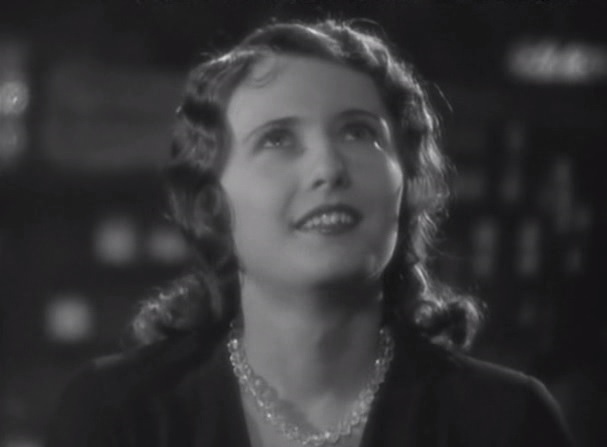
The scene where Jerry goes to cover Kay with a blanket. Capra keeps the rhythm of the scene achingly slow, with Stanwyck trying to sleep and the rain beating gently against the windows. Capra always said he found rain romantic and uses the image of it here to effectively seal the lovers off in a private world of their own. Walker takes advantage of the rain to cast a flickering play of light and shadow on Stanwyck's expressive face, as if her thoughts are changing with every raindrop. Kay hears Jerry's footsteps at the door and you can see the realization dawn on her face that the man she cares for is just coming to use her, like every other man she's known. She closes her eyes, pretending to sleep. Then she feels, Jerry drawing the blanket over her and Capra cuts to a simple shot of his feet, walking away. Cut back to Kay, radiant with delight. In a gesture she would find again for Stella Dallas, Stanwyck bites the blanket with her teeth and stares up at the ceiling, smiling (in an earlier scene she had mocked Jerry for making her stare raptly at a ceiling). It's a blissfully sweet and sensual scene that captures the moment when a cynical, broken woman gives herself over completely to love.

Final Six Words:

Stargazing romance with transcendent Stanwyck performance