Saturday, July 30, 2011

Movie Review: Night of the Demon/Curse of the Demon

Night of the Demon/Curse of the Demon* (1957)
directed by Jacques Tourneur, starring Dana Andrews, Peggy Cummins, Niall MacGinnis

*Night of the Demon was the original British title. For the American release, the film was edited and re-titled Curse of the Demon. For clarity's sake, I'll refer to the film in my review as Night of the Demon since I chose to view the original, uncut British version.

(Note: This is my entry for the '50s Monster Mash Blogathon, hosted by Forgotten Classics of Yesteryear.)

The renowned Dr. John Holden (Dana Andrews), an expert on hypnotism and superstition, flies to England to attend a symposium on the supernatural. Holden plans to participate in an investigation of a mysterious devil-worshiping cult and their eccentric leader Julian Karswell (Niall MacGinnis). However, when Holden arrives, he finds out that one of his colleagues, Professor Harrington (Maurice Denham), has died under mysterious circumstances. Karswell appears to Holden and warns him away from proceeding with the investigation, but Holden laughs it off. His skepticism is challenged by the arrival of Joanna Harrington (Peggy Cummins), Professor Harrington's niece, who believes her uncle was killed by something supernatural, something to do with Karswell's cult. The two team up to find out the truth. 

Holden refuses to admit the existence of the supernatural, but how does he explain the strange events happening around them? Why does he feels chilled when the weather is hot, why does he see visions of living smoke, and how does Karswell appear to summon wind storms and wild cats? Holden is further puzzled by finding a scrap of paper slipped in amongst his things, with runic inscriptions on it. Holden and Joanna discover that Professor Harrington received a similar paper, three days before he died. With the furtive help of Karswell's elderly mother, (Athene Seyler), the pair find evidence to suggest that Holden too is doomed to die in three days. Unless he can find out the secret of the runes before it's too late. Before he is caught by Karswell's curse. The curse of the demon.


Night of the Demon was based on M.R. James' classic story, "The Casting of the Runes," often acclaimed as one of the greatest scary stories of all time. In James' original tale, the focus was on a mild-mannered academic named Dunning, who becomes the target of the mad and bad Mr. Karswell, after Dunning rejects Karswell's rather incoherent paper on alchemy. Mysterious things begin to happen to Dunning. He sees cryptic messages, he feels nervous all the time, his servants mysteriously develop poisoning symptoms. It's only after he encounters John Harrington, brother of the late Henry Harrington, that he begins to understand what happens to the enemies of Mr. Karswell. And what may happen to him. The power of James' story comes from the dry, understated way these unsettling details begin to pile up, the way the darkness peeks out between the cracks of the maddeningly deliberate prose. 

Jacques Tourneur's film takes this story and manages to craft a great horror film that honors its original source material while managing to deepen and enrich the story's themes. Night of the Demon changes the protagonist from a conventional British academic to a hard-headed American scientist named John Holden, whose journey to England results in a clash not just of culture, but of science against superstition. As one of his colleagues tells him, "Take it kind of easy on our ghosts. We English are sort of fond of them." The John Harrington of the story becomes Joanna Harrington, the niece of the mysteriously dead Professor Harrington. She helps Holden try to uncover the mystery of Mr. Karswell, who has been promoted from the frustrated academic of the James story into a powerful cult leader. James' story clung to the ordinary trappings of English life; the action was confined to railway cars, hotels, and small private rooms. Tourneur's film ranges all over, taking Holden from apartment buildings to isolated farmhouses to a spooky manor house, even to Stonehenge. And unlike the original story, which plays as an exercise in "is it or isn't it," Night of the Demon boldly opens with the gambit of actually showing the reality of its supernatural threat, as personified by the demon.


The question of the demon has plagued fans of this film since the very beginning. There is one camp, let's call them Anti-Demon, who swear up and down that Jacques Tourneur never planned to actually show the demon in the movie and that its actual appearance is a serious letdown from a subtle psychological horror film. For the record, Tourneur himself was in the Anti-Demon camp and remarked in interviews that the creature's appearance was forced on him by producer Hal E. Chester. But there's also a Pro-Demon camp, who insist that the demon is genuinely frightening and that the movie wouldn't be nearly as satisfying without it. Author Tony Earnshaw, in his book Beating the Devil: The Making of the Night of the Demon, claims that the demon's appearance was planned from early on, rather than shoehorned in at the last minute.

For myself, I have to stand in the Anti-Demon camp. It isn't because I think the monster shouldn't have been shown, it's because of how it's shown. At first when we see the demon, it always appears from a distance, shrouded in smoke and slightly blurry, so that it could be mistaken for an illusion. In those moments, it's genuinely unsettling, this strange black something that's coming closer and closer. Tourneur, quite craftily, always places the demon in settings where its appearance echoes something more ordinary. There's not much difference between a monster and the flash and smoke of an oncoming train. Or much difference between a demon and the sparks of a crashing telegraph pole.


It's only when the film suddenly zooms into a close-up of our monster, as in the still above, that all mystery vanishes and it becomes just another '50s movie monster. And it's not bad by '50s movie monster standards, it's just that it seems so out of place with the almost subliminal glimpses we were getting before. There's one lingering shot of the demon shaking a man like a rag doll that veers straight into comedy. It doesn't feel organic to the film, it feels like a money shot, like the filmmakers are telling us we got our money's worth in special effects horror. There's a similarly silly moment earlier in the film, when Dana Andrews is attacked by a cat that morphs into a leopard (call-back to Lewton and Tourneur's Cat People?) and the camera lingers long enough for us to realize that Andrews is fighting a stuffed cat. And I think these problems aren't because of bad special effects (Modern CGI would be just as much of a let-down), it's because these shots don't fit with an otherwise suggestive film. Night of the Demon ends on the words, "Maybe it's better not to know," and in this case, the film should have taken its own advice.


That complaint over with, I am free to linger over the many strengths of this film. Aside from the demon itself, Night of the Demon's production design is gorgeous; each set we see is carefully detailed and feels exactly right for the character that inhabits it. The strange geometrics of Karswell's mansion with its spiral staircases, Holden's cramped apartment, Joanna's striped wallpaper in the firelight, it's all fantastic. I kept wanting to pause the movie to linger over the details and I'm sure there are worse ways to spend an afternoon than in trying to parse the visuals of this film. 
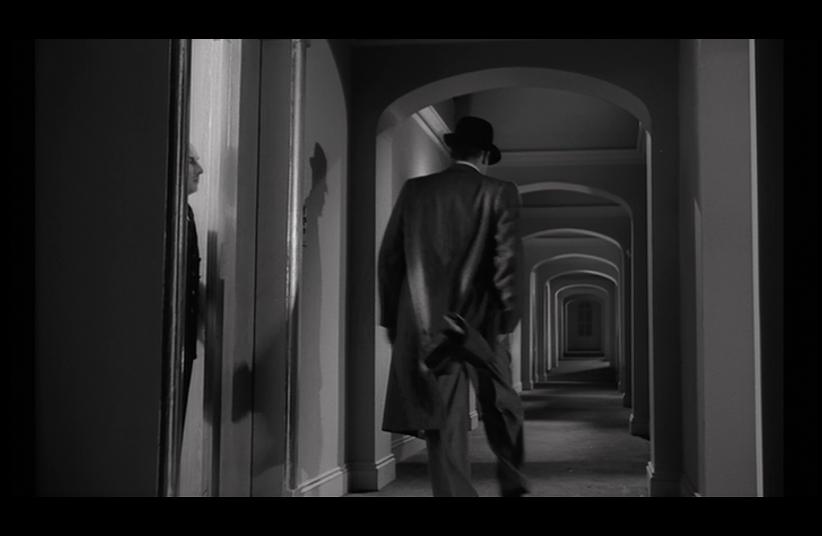


Jacques Tourneur's direction here is on par with his best work. Night of the Demon creates a mesmerizing, disquieting world, in which every shot seems designed to constrict your breathing. You can spot a lesser horror film by the way the movie deflates in between shock moments, as if the director doesn't know what to do when there's no big scary thing to shake in your face. Here though, Tourneur never loosens his grip. The echoing corridors, the barren countrysides, everything reflects back the fear and paranoia that slowly begins to grip our protagonists. Even a library becomes a horrifying labyrinth straight out of Crete. Tourneur mainly eschews "gotcha" tricks in favor of a suffocating sense of unease that occasionally veers into the hallucinatory. The way Holden's point-of-view sometimes blurs; is it a sign that he's losing his hold on reality? The way a hand appears on a balustrade, seemingly out of nowhere. In Night of the Demon, there's no easy distinction between the ordinary and the supernatural. They exist together.


At this point in his career, Dana Andrews was very much a sideliner, his alcoholism having relegated him to B-parts. In her brilliant essay on the career of the fascinating and vastly underrated Andrews, Imogen Sara Smith writes, concerning his work in Night of the Demon, that "the slur in his voice and uneasiness in his manner make him intriguing in a role that could have been played by Kent Smith." There was always that unease to Andrews, that lurking discomfort underneath the surface, so it's interesting here to see him play a character who is so determined not to look beneath the surface. The hyper-rationalist character of John Holden is, in fact, so stubborn, so smug and self-assured, that the film's sympathy often shifts away from him to the side characters. Even a group of daffy seance-seekers singing "Cherry Ripe" seem more reasonable. It's only by admitting his fears and doubts, however, that Holden can find a way to fight Karswell. And their battle of wits is something to see, indeed.


It's always a treat to see the talented Peggy Cummins although she doesn't really get to stretch herself as the "horribly bright" Joanna Harrington. Joanna, the professor's niece, is a bit of a stock character. B-movie scientists always seem to have a surplus of beautiful nieces/daughters/granddaughters that pop up out of nowhere, carrying research notes and ready to risk their lives. Still, Cummins adds some spark to the character and Joanna's willingness to accept the supernatural is the necessary foil to Holden's skepticism. Her best moment is when she snaps at the perpetually condescending Holden, "Please don't treat me like a mental patient who has to be humored. I also majored in psychology."


But the real treasure of this cast is Niall MacGinnis as the charming but sinister Julian Karswell. I don't think I'm exaggerating when I say that this has to be one of the great horror movie villains of all time. At first glance, he's like a cross between Clarence the Angel and Mephistopheles. He threatens, but with a smile and a joke. He's fond of children and his mother, but he also summons demons from hell. He seems confident in his dark powers but to his mother, he confesses the terrible cycle he's caught in. "My followers who pay for this do it out of fear. And I do what I do out of fear also. It's part of the price." Unlike the Karswell of the original short story, a "horrible man" who combines the evils of devil worship with the evils of badly written papers and whose only actions are malignant and petty, the movie Karswell is more fascinating. He's unpredictable, which makes him all the more powerful as an enemy. But there's also a shred of sympathy for his character, who must continually find new victims or else become a victim himself. Ironically, our hero Holden has to find that same ruthlessness within himself by the finale, if he plans to survive.


It's hard to write a review for a film like this without feeling you've only barely scraped at the surface; it's just that fascinating. You could watch it solely for the beauty of Tourneur's visuals. Or you could watch it for the sly humor of Charles Bennett's script. Or for the moment when Dana Andrews stands next to Stonehenge, utterly dwarfed by the mysteries he knows not. Or watch it so that you and your friends can have a rousing debate of Pro-Demon/Anti-Demon. It's a fine horror film and eminently worthy of its cult status.


Favorite Quote:

"How can you give back life? I can't stop it. I can't give it back. I can't let anyone destroy this thing. I must protect myself. Because if it's not someone else's life, it'll be mine. Do you understand, Mother? It'll be mine."

Favorite Scene:

For my money, the party scene at Karswell's house is just about perfect. Holden and Joanna go to Karswell's property to question him and are taken aback by the luxury and size of the place, hardly appropriate for the home of some crackpot con artist. And when they find Karswell, what is this master of dark magic doing? Why, he's dressed up as a clown and doing magic tricks for the local children ("A magic puppy! Now, who'd like to stroke a magic puppy?"). And his mother's even making ice cream. This is one instance of the film completely reversing a scene from the original story. In "Casting the Runes," Karswell is a sadist, who gives the local children a gruesome slide show in order to terrify them.  Here, Karswell is genuinely sweet to them, which makes the underlying menace of his character all the more interesting. As he and Holden pass by a pair of kids playing a game of Snakes and Ladders, Karswell remarks whimsically that he always preferred sliding down the snakes to climbing up ladders. Holden responds that maybe it means Karswell's a good loser. Karswell turns to him, coldly serious. "I'm not, you know. Not a bit of it."

Final Six Words: 

It's in the trees! It's coming!

Wednesday, July 20, 2011

Tough Guy Names


So I was reading Tom Shone's post about the reported return of Kevin Costner's dark side in Django Unchained and suddenly I was filled with joy and anticipation. Not because Costner is acting again but because he would be playing the character of Ace Woody. If there's one thing that current cinema is missing, it's tough guy names like Ace Woody. And that got me thinking about the many Golden Age films (mainly Westerns and Warner Bros. flicks) that weren't afraid to name their heroes things like Cole Harden. I miss that. Here's hoping that Tarantino can bring the tradition back.

And now, here's a sample of Golden Age actors and their manly, manly names:

Gary Cooper

Cole Harden in The Westerner
Blayde Hollister in Dallas

Clark Gable

Ace Wilfong in A Free Soul
Big John McMasters in Boom Town

Humphrey Bogart

 Whip McCord in The Oklahoma Kid
Gloves Donahue in All Through the Night
Rip Murdock in Dark Reckoning
Dixon Steele in In a Lonely Place

 John Wayne

Duke Slade in Adventure's End
Wedge Donovan in The Fighting Seabees
Chance Buckman in Hellfighters

 Randolph Scott

Brazos Kane in Gunfighters
Ransome Callicut in The Man Behind the Gun
 Buck Devlin in Shoot-Out at Medicine Bend
 Ben Brigade in Ride Lonesome

 Alan Ladd

 Salty O'Rourke in Salty O'Rourke
Whispering Smith in Whispering Smith
Hugh Tallant in Botany Bay

Ronald Reagan

Brass Bancroft in Secret Service of the Air, Code of the Secret Service, Smashing the Money Ring, and Murder in the Air
 Vance Britten in The Last Outpost
Webb Sloane in Prisoner of War

Tuesday, July 19, 2011

5 Movie Costumes I Love (Summer '11 Edition)


Ever since the Siren's great post about film fashion, I've been itching to post my own list of my favorite movie costumes.  I make no claims to being a knowledgeable fashion blogger (psst, go visit The Silver Screen Modiste's excellent blog). This is just for my own personal enjoyment, a way for me to talk about how much I enjoy costume on film. Rather than try to fit all my favorites into one epic post, I decided to make it a regular series on this blog. That way, I can be as slapdash as I like, without fretting over what I've missed.

However, in order to make the lists more interesting, I gave myself three restrictions:
  1. Absolutely no costumes from an Alfred Hitchcock film.
  2. No costumes worn by Grace Kelly.
  3. No costumes worn by Audrey Hepburn.
With that said, here are a few of my personal favorites.

1. Katharine Hepburn in Bringing up Baby
Costume Design by Howard Greer
("The Nightclub Dress") 


Of course, everyone remembers the scene where this dress gets ripped, but what about the brilliance of the dress itself? In many ways, it's the epitome of 1930s elegance, gold lamé, floor-length, hugging Hepburn's form beautifully. But it's also completely ridiculous. Look at the way that ribbon appears to float around Hepburn's head. It's like the costume equivalent of someone drawing circles around her head as if to say, "Yeah, this dame's completely dizzy." And watch how Hepburn moves in it. She doesn't mince or pose, she strides. She has total confidence. She's comfortable in this dress. Which makes it all the funnier when she has to shuffle out with Cary Grant blocking the view of her ass. Still, it's a perfect example of a costume that gives you the entire character in one moment. Beautiful, cuckoo-crazy Susan Vance. Bless her.

2. Leslie Caron in Gigi  
Costume Design by Cecil Beaton
("The Maxim's Dress")


Cecil Beaton won an Oscar for his work on Gigi and deservedly so. The film's climax is a classic moment of the awkward girl suddenly revealed as the beautiful woman and it still packs a punch. The film builds us up to it gradually, we begin to see Leslie Caron in longer dresses, higher collars. But her costumes are still pretty demure and girlish until the moment when she enters wearing this. Forget "Thank Heaven for Little Girls," forget the title song, it's this dress that shows us how girls can grow up.

3. Barbara Rush in Bigger than Life 
Executive Wardrobe Design by Charles Le Maire, Costume Design by Mary Wills
("The Orange Dress")


I'm convinced that Alfred Hitchcock was somewhere in the theater for Bigger than Life taking notes for Vertigo. In one queasily brilliant scene, James Mason's character, Ed Avery, is fully in the grips of a manic episode brought on by cortisone, and insists on dragging his wife Lou (Barbara Rush) through the most expensive dress store in town. His act of generosity becomes one of ruthless control, as he forces his reluctant wife to take home far more dresses than she wants. The only one she does want is this orange number that reappears to great effect in the film's finale. And what a dress it is. It's shockingly bright, like a flashing neon sign in the couple's cramped suburban home. It's a sophisticated style, but it overwhelms poor Lou. The flaring collar, the swirling skirt, the stiff material--it's like the dress is choking her. Her character may be suffering in silence but there's nothing silent about that dress.

4. Gene Tierney in The Ghost and Mrs Muir
Costume Design for Gene Tierney by Oleg Cassini
("The White Beach Dress")


Gene Tierney's parents tried pretty near every trick in the book to stop her from marrying dress designer Oleg Cassini. But Tierney's movies prove that, in one respect at least, Cassini was a savvy choice. Because damn if that man didn't know how to dress his wife. It didn't matter whether she was in contemporary or period fashion, Tierney still looked great. While The Ghost and Mrs. Muir isn't her most dramatic onscreen look (she is supposed to be playing a poor widow at the turn of the century), it shows the progression of her character just perfectly. In the first few scenes, the widowed Mrs. Muir is swathed in black. Then, as her character begins to feel freer and more confident, she progresses to lighter colors and patterns. But when Mrs. Muir suddenly appears at the film's midpoint in this floaty white beach dress, the breeze ruffling her hair and brushing her bare arms, it's a striking moment of a character's romantic yearnings come to visual life. Her movements are looser and as Bernard Hermann's dreamy score follows her up the road, she looks like she's in a fairy tale. And when she meets George Sanders on that road and begins to fall for his charm, it feels inevitable. No woman could wear that dress, looking like Tierney does, and not feel romantic.

5. Norma Shearer and Herbert Marshall in Riptide  
Costume Design by Adrian
("The Insect Man and Lady Skybug Costumes")


Okay, I'll admit it, I haven't actually seen this movie, other than the brilliant opening sequence posted on Youtube. But c'mon. Are these not the most fantastic costumes in the history of Meet Cutes? When an Insect Man meets a Lady Skybug, what else can they do but fall in love?


Note: The Bigger than Life screencap is credited to Brandon's Movie Memory and the Ghost and Mrs. Muir one was taken from This Island Rod.

Saturday, July 9, 2011

Who Died it Better?


"Ali MacGraw's Disease: Movie illness in which the only symptom is that the sufferer grows more beautiful as death approaches. (This disease claimed many screen victims, often including Greta Garbo.)" --Roger Ebert


So I ask you, readers, in the art of dying, who was the fairest of them all?

Thursday, June 30, 2011

Blogathon Round-Up


So, the Roger Corman Blogathon has wrapped it up. With a grand total of 21 entries, each on a different Corman film. This was an incredibly fun blogathon and I think Corman himself would have been impressed with the creativity, humor, and smarts of all those who participated. And of course, the enthusiasm of our host Nathanael, the man behind Forgotten Classics of Yesteryear, was an inspiration.

On a different corner of the blogosphere, Caroline over at Garbo Laughs, brought us the Queer Film Blogathon on June 27th. And damn, I knew it was going to be good, but it wasn't until I started digging through the entries, that I realized just how brilliant my fellow bloggers are. There were over 60 entries and although I still haven't shoveled my way through all of them, I haven't found a weak entry in the bunch. And Caroline led the way with her own excellent analysis and insight. 

I think my favorite part of blogathons, even more than the writing or the reading, is meeting people from all corners of the blogosphere. Experts in horror film, classic film, foreign film, independent film. And then people who weren't film bloggers at all, but ventured out anyway. I got to chat with so many different people. Smart, talented, funny people. It's amazing and kind of awe-inspiring. I know that by the time the next blogathon rolls around, I'll be working furiously to up my game.

Oh, did I say next blogathon? 'Cause there's another one coming up.


The inexhaustible Nathanael, fresh from conquering the Worlds of Corman, has declared a new blogathon: Monster Movie Mania!

From July 27th through August 3rd, he'll be hosting a celebration of 1950s monster movies. Nate can explain it better than I can, but basically, participants choose a movie that was made from 1950 to 1959 that features some kind of monster. That includes aliens, demons, robots, mutated humans, mummies, vampires, anything so long as it's from the 50s. The film can be from any country, so you're not limited to Hollywood. Anyone who's interested can pop over to his blog and choose a film to review. It's first-come, first-served, so better hurry over and pick your flick. Nate is also promising awards and prizes, as he did for the Corman blogathon (Nate, if you're reading this, I think you spoil your bloggers), so if you need a little incentive...

I'm looking at this list right now and I notice nobody's picked The Fly yet. Or The Incredible Shrinking Man. And I Married a Monster from Outer Space is still available. Grab 'em while you can, people.


And if you need some help getting in the mood, Where Danger Lives is starting a Countdown of the 50 Greatest Classic Sci-Fi Posters. Not to be missed.

Monday, June 27, 2011

Movie Review: Sylvia Scarlett

Sylvia Scarlett (1935) 
directed by George Cukor, starring Katharine Hepburn, Cary Grant

(Note: This is my entry for the Queer Film Blogathon, hosted by Garbo Laughs.)

One day, young Sylvia Scarlett (Katharine Hepburn) gets an unpleasant shock: her father Henry (Edmund Gwenn) has embezzled from the lace factory and now, there is nothing to do but go on the run. Sylvia convinces her father that the police won't be on the lookout for an embezzler and his son, and with one twist of the scissors, Sylvia becomes Sylvester. 

However, just as Sylvia is becoming comfortable in her new identity, her father bumbles into the path of Jimmy Monkley (Cary Grant), a Cockney con artist. Fortunately or unfortunately for the hapless Scarletts, Monkley takes a shine to them and enlists them as his new partners. To Monkley's disappointment, the Scarletts are more of a hindrance than a help until Sylvia gets the bright idea for them to form a traveling player troupe, with the help of a ditzy housemaid named Maudie (Dennie Moore). 

While performing, they make the acquaintance of aristocratic artist Michael Fane (Brian Aherne) and his snooty girlfriend Lily (Natalie Paley). Sylvia quickly falls for Michael, who's quite taken with this hot-tempered, free-speaking boy. From there, it becomes a romp of Shakespearean proportions, as Sylvia and her cohorts are quickly entangled in deceptions both romantic and criminal.

  
Sylvia Scarlett was one of the more notorious flops of the 1930s. At the time, audiences did not know what to make of the film's strange plot or of Katharine Hepburn in drag. Nowadays, Sylvia Scarlett stands as one of Hollywood's early and more interesting experiments in examining gender roles.

In the film's opening scene, Sylvia, after learning of her father's embezzlement, suddenly decides to pass herself off as a boy. She removes her long braids and switches her luggage label from Sylvia to Sylvester and that is that. The speed of her decision, as well as the enthusiasm with which she goes about it, is the film's first hint that Sylvia's cross-dressing might not be for the reasons she says it is. Her flimsy justification that the police will be thrown off if her father Henry is traveling with a boy and not a girl doesn't really hold water (Henry, it should be mentioned, doesn't make any attempt to disguise himself). And as the film wears on, well after it becomes clear that the police aren't going to catch up with them, Sylvia remains in her masculine identity.


Katharine Hepburn is nobody's idea of a convincing boy, but this is not a film where realism is paramount or even wanted. Hepburn makes some attempt to distinguish the two personalities by speaking in a high-pitched, trembling voice for her scenes as the girl Sylvia. Interestingly, the voice and mannerisms she uses for the boy Sylvester feel a lot more like authentic Hepburn than the girlish ones do; Hepburn's opening scene as the tearful, pigtailed young girl (with an on-again, off-again French accent) plays like parody. It's only when Sylvia dons drag that she feels relaxed and free.

As a boy, Hepburn's movements become easier, her laugh more open. Her attitude changes as well;  the timorous heroine of the opening scene becomes a pugnacious, spirited young man, who's more than willing to take a sock at anyone. Sylvia's performance of being male is clearly tied to her ideas of what being male means. The idea of a woman posing as a man in order to find freedom is nothing new (Shakespeare's heroines are a big believer in it), but Cukor's film adds another dimension to the idea: Sylvia is not only more comfortable as a boy, but doesn't know how to be a girl. This becomes obvious in the second half of the film when Sylvia, having fallen in love with the rakish artist Michael Fane, finally discards her boyish identity in order to woo him.


George Cukor later went on record as saying that the film loses interest in its second half when Sylvia goes back to being a girl again. He's right in saying this, but it isn't because the plot becomes weaker or because the character becomes less interesting, it's because Hepburn's performance goes seriously downhill. Her movements are fluttery and exaggerated, she mugs for the camera, and always seems to be on the verge of breaking out in a sobbing or giggling fit. Sylvia the cross-dresser is interesting, but Sylvia the girl is a ninny.

And I don't think this was due to the script, since the character's actions aren't necessarily weaker; she retains the decisiveness and independence of her boy persona (even jumping into the ocean to rescue her romantic rival). It's Hepburn's performance that weakens her. Considering how well Cukor and Hepburn would work together on other occasions, as well as Cukor's reputation as one of the great directors of actors, it's hard to believe that the acting choices weren't intentional. But they made a mistake. After all her experiences, Sylvia should be stronger as a character, not weaker. And considering that the film's other two main female characters are, respectively, the foolish, unfaithful housemaid Maudie, and the snooty, unfaithful society girl Lily, the implications of Hepburn's performance become a little uncomfortable.


I realize that I've spent most of this review not talking about the plot but in the case of Sylvia Scarlett, the plot is incidental to the antics. Sylvia and her father Henry go from being outlaws on the run to con artists to theatrical troupers, without much difficulty. In spite of the fuss about Henry's embezzlement, there's very little urgency to their renegade lifestyle (the law enforcement doesn't seem to be interested in following them) and much of the action seems to take place on a cloud of pink champagne and gaiety. The characters play a lot of their scenes either drunk or wishing they were. Whenever a new deception is unmasked, the characters respond not with anger, but with delight.

But George Cukor isn't trying to make a serious film about criminals. The fluidity of the way Sylvia can switch gender roles is matched by the way other characters can switch their identities, from criminal to theatrical. In that respect, Sylvia Scarlett might be taken as one of Cukor's more personal films. As more than one critic has noted, Cukor was fascinated by performance and theater, and his films reflect that fascination. Many of them are about the lives of people who perform for a living, as in What Price Hollywood?, Dinner at Eight, Camille, A Double Life, The Actress, A Star is Born, and Les Girls. The cleverness of this film is the way Cukor hints that every role in society is a kind of performance, whether it's your gender or your social class.

Sylvia Scarlett began life as a book by Compton MacKenzie, The Early Life and Adventures of Sylvia Scarlett. Possibly that is why this film, unlike Cukor's more polished adaptations of popular plays, feels rambling and unfocused. Characters switch their minds on a whim, romantic attachments are made and broken with ease, and the atmosphere swings from brightly cheerful to dark and even tragic at times. But it's that same quality that gives Sylvia Scarlett its charm; it's like a traveling companion that can't resist pulling you off the path to come look at whatever new shiny thing happens to catch their eye.


Aside from its examination of gender roles, Sylvia Scarlett is known as arguably the first film where Cary Grant's star persona really began to take shape. Here, he plays a charming, amoral Cockney con man Jimmy Monkley, annoyed by Sylvia but also amused by her. In one of the film's funnier scenes, Grant strips off his shirt and invites "Sylvester" to join a bed with him in the caravan, telling her, "You'll make a proper hot water bottle tonight." But there's an element of menace to Grant's character; Monkley's introduction is straight out of film noir, standing in the fog, his face lit but his body in shadow, staring silently at the frightened Scarletts. After a few altercations, he joins forces with Sylvia and Henry, but makes it clear that he's not going to be bound by any ethical constraints. Even when his con games fail (usually because Sylvia bungles something), Monkley still carries on. Towards the end of the film, Monkley even manages to resolve a love triangle by kidnapping an unconscious woman.

While his Cockney accent is less than convincing, Cary Grant brings all of his talents to the role of Monkley. His charm, his theatrical and acrobatic training, and the ability to make a cad look charismatic. And since it wasn't yet de facto that Cary Grant would get the girl, it allows Grant to play a friendly (and suggestively homoerotic) role in relation to Hepburn. It's certainly their most unusual pairing together.


The failure of Sylvia Scarlett at the box office is a shame, because the film is one of the most interesting of its decade. There were other films of the 30s that explored the potential of cross-dressing (Queen Christina and Marlene Dietrich's tuxedos come to mind), but Sylvia Scarlett really does take the premise in fascinating directions. At times, it almost seems like Cukor was drawing on some obscure Shakespeare play. And if the film does start to lose some of its sparkle and energy by the end, it remains as a brilliantly subversive and funny examination of the role-playing inherent in gender, crime, and art. As Shakespeare would have it, "All the world's a stage and all the men and women, merely players."

Favorite Quote:

"Well, we're all fools sometimes. Only you choose such awkward times."

Favorite Scene:

I'm going to cheat a little here, since my favorite scene is more like two scenes melting together. Sylvia, Henry, and Monkley are in the mansion of Maudie's employers. Maudie believes that Henry is a theatrical impresario, ready to sign her on and flirtatiously consents to put on her mistress's jewels for the big audition. But Sylvia, due to a sudden attack of drunken honesty, forces Monkley to reveal to Maudie that they were planning to rob the place, using her. Maudie is shocked and Monkley is about ready to knock Sylvia's block off. But then, just as Maudie is bemoaning her bad luck ("Now, I shall have to stay here, slaving away, instead of performing by the sea") a light bulb goes off in Sylvia's head. "But we must perform by the sea!" she shouts. They could be real performers, they could get a caravan...Monkley shakes her off but Sylvia persists. And then Henry and Maudie join in. Maudie tells them to take her savings. Monkley turns away, trying to resist, and then finally gives in to the carnival spirit. Henry starts up a round of "I Do Like to Be Beside the Seaside." The con artists and their erstwhile victim end up jigging on the staircase because, oh well, why not? The great joy of this film is its upside-down logic. In this world, deception doesn't drive people apart. It brings them together.

Final Six Words:

Sparkling, rambling celebration of crossing boundaries